Download
1 / 8
80 likes | 203 Vues
This document outlines the key issues discussed during the interim meetings focused on the Networked Services Layer Protocol (NSLP) for Quality of Service (QoS). It covers various topics such as receiver-initiated reservations, query mechanisms, and session binding. The discussion highlights points on message priority handling, refresh overhead reduction strategies, and the significance of the Resource Identifier Information (RII). Additionally, it delves into error handling, emphasizing the need for clear error codes. The document aims to refine the NSLP design and improve overall reservation processes.

E N D
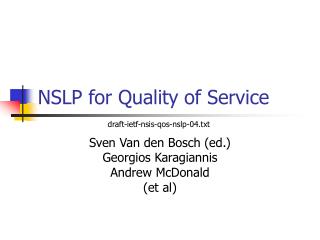
NSLP for Quality of Service draft-ietf-nsis-qos-nslp-04.txt Sven Van den Bosch (ed.) Georgios Karagiannis Andrew McDonald (et al)
Issues discussed at interim • Receiver-initiated reservation • Use empty QUERY for ‘PATH’ • Receiver-initiated resv. over reduced-state domain • Session binding informative in nature • Flags made positive • Remove NO_FATE_SHARING flag • Does not explicitly provide fate sharing (can be handled by endpoints) • Refresh reduction • MRI must always be passed
Issues discussed at interim • Priority • Message priority: transfer attributes • Reservation priority: QSPEC issue, one level • Use SCOPING only in QUERY/RESERVE • RII • Clarify global RII versus local RSN significance • make RII a separate object, carried in QUERY/RESERVE and RESPONSE • Object formats: TLV
Closed open issues on • Priority of reservations • GIMPS Modifications for Refresh Overhead Reduction • Path state maintenance implementation at NSLP or NTLP • Resource sharing • RESERVE/COMMIT • One-sided bidirectional reservation
Changes in -04 • Clarifications • Aggregation: document does not specify how to aggregate end-to-end reservation but rather how such an aggregate can be signalled for • QSPEC stacking • Made RII a separate object (outside of SCOPING) • Removed RESPONSE_REQUEST • Made SCOPING a flag rather than an object • Added object format for ERROR_SPEC object • See next slide
ERROR_SPEC object format • first byte of error code indicates severity • 0x01 - Informational • 0x02 - Success • 0x03 - Protocol Error • 0x04 - Transient Failure • 0x05 - Permanent Failure • Currently defined error codes: see document +-------------+-------------+-------------+-------------+ | 0x0005 | variable length | +-------------+-------------+-------------+-------------+ | Error code | +-------------+-------------+-------------+-------------+ | | // Optional variable length error-specific information // | | +-------------+-------------+-------------+-------------+
Mailing list discussions • Need for ‘OK’ error code (resolved) • Proposal to add a ‘meaning’ object to a message (open) • E.g. encode ‘TEAR’ in this object iso flag • Useful to have the concept of ‘TEAR’ [Yes] • What is the best way to encode? • In a flag [now] • In a separate ‘meaning’ object • As a separate message type
Open issues • Authorization • See discussion on draft-tschofenig-nsis-qos-ext-authz-00.txt • Error codes • Include in message/object processing text, if OK