Enhancing International Cooperation Through Summer Schools: Insights from the Euroleague for Life Sciences
This paper explores how summer schools serve as effective platforms for fostering international cooperation in higher education. Utilizing the experience of the Euroleague for Life Sciences and the ICA Regional Network for Central and South-Eastern Europe, it highlights the benefits of short-term programs tailored to student needs, with a focus on networking, student feedback, practical training, and cultural exchange. Key advantages include easy enrollment, support for student mobility, and the opportunity to engage with diverse cultures, paving the way for advanced cooperation in science.

Enhancing International Cooperation Through Summer Schools: Insights from the Euroleague for Life Sciences
E N D
Presentation Transcript
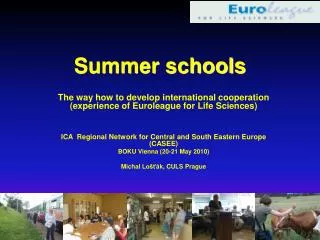
Summer schools The way how to develop international cooperation (experience of Euroleague for Life Sciences) ICA Regional Network for Central and South Eastern Europe (CASEE) BOKU Vienna (20-21 May 2010) Michal Lošťák, CULS Prague
Why Summer Schools • The most simplest form of joint programmes (ECTS) with the potential to build networks for future sophisticated cooperation (example BOKU-CULS-WULS) • Very efficient (short) and flexible (easy to tailor to the needs of the students) • International milieu of teachers and students (different cultures) + international feedback to the students and teachers (first steps towards international science for the students) • Additional form of education (however: problem of the time in summer) • Supports short term mobility • Social networking • Easy enrollment • IP Erasmus (wetlandwater management summer school)
Benefits of summer schools: • Lectures for students (shorter) • Presentations of students papers about their degree thesis (reactions of students and teachers) • Individual works of the students • Use of university labs and facilities • Practical training (solving real problems) + field trips • Presenting the findings to the stakeholders • Cultural experience