The Impact of Educational Field Trips on Student Learning in Microbiology
This study explores how customized educational field trips enhance students' understanding of microbiology at Thompson Rivers University. In courses like Industrial Microbiology and Introductory Microbiology, students participate in field trips to breweries, wineries, sewage treatment plants, and pathology laboratories. The research evaluates student learning through pre/post-concept tests, reflective papers, and surveys on career awareness and attitudes towards microbial activities. Findings indicate that field trips significantly enrich student engagement and motivation while correcting misconceptions about the field.

The Impact of Educational Field Trips on Student Learning in Microbiology
E N D
Presentation Transcript
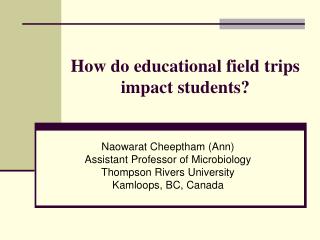
How do educational field trips impact students? Naowarat Cheeptham (Ann) Assistant Professor of Microbiology Thompson Rivers University Kamloops, BC, Canada
Context • Courses (CMMB major) • Senior: BIOL449 Industrial Microbiology(12-24 major students, no lab, meet 3 hrs a week, 13 weeks, offered in the winter semester from Jan to Apr), Beer brewery, Winery, and Cheese factory field trips. • Sophomore: BIOL 220 Introductory Microbiology(64-80 major students, 2 hrs lab a week, class 3 hrs a week, 13 weeks in the winter semester from Jan to Apr), Sewage treatment plant, drinking water treatment facility, and RIH pathology laboratory. • Learning objectives • Recognize the role of microorganisms in our life on a daily basis and in local community. • Understand some microbiological concepts. • Develop an awareness of possible careers in the field.
Why? • Customized field trips! • Value added to pedagogical approaches in teaching microbiology and biotechnology. • Uncover some misconceptions about field trips in this economy downward climate.
Experimental Design • Pre/post course concept tests • Between topics chosen (with and w/o field trips) • a report after the field trip (reflective paper) • Pre/post attitudinal surveys • Appreciation of microbial activities and products • Career awareness • Motivation