Download
1 / 37
370 likes | 485 Vues
This guide provides essential insights into the brightness and temperature of stars, detailing key formulas such as the relationship between surface temperature and peak wavelength (λmax) and the definitions of apparent and absolute magnitude. It explores concepts like luminosity, Stefan-Boltzmann law, and the inverse square law for brightness. With practical examples, like calculating the luminosity of the Sun and determining the apparent magnitude of distant stars, this resource lays a solid foundation for understanding stellar characteristics and their significance in astronomy.

E N D
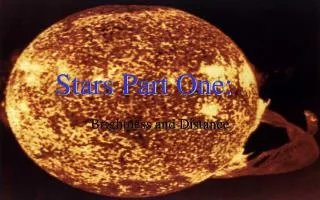
Stars Part One: Brightness and Distance
Concept -1 – Temperature λmax (metres) = 2.90 x 10⁻³ m k T (Kelvin) λmax = Peak black body wavelength T = The star’s surface temperature in Kelvins
λmax = 2.90 x 10⁻³ m K T λmax From Jay Pasachoff’s Contemporary Astronomy
Put this in your notes: A star has a surface temperature of 5787 K, what is its λmax? λmax = (2.90 x 10⁻³ m K)/T = (2.90 x 10⁻³ m K)/5787 = 501 nm 501 nm
A star has a λmax of 940 nm, what is its surface temperature? λmax = (2.90 x 10⁻³ m K)/T, T = (2.90 x 10⁻³ m K)/ λmax = (2.90 x 10⁻³ m K)/ (940E-9) = 3100 K 3100 K
Concept 0 – Total power output Luminosity L = σAT4 L = The star’s power output in Watts σ = Stefan Boltzmann constant = 5.67 x 10⁻⁸W/m2K4 A = The star’s surface area = 4πr2 T = The star’s surface temperature in Kelvins
Put this in your notes:Our Sun has a surface temp of about 5787 K, and a radius of 6.96 x 10⁸ m. What is its Luminosity? L = σAT4 = 5.67x10⁻⁸(4π(7x10⁸ ) 2 )(5787)4 = 3.87x1026 Watts 3.87x1026 Watts
A star has a radius of 5.0 x 10⁸ m, and Luminosity of 4.2 x 1026 Watts, What is its surface temperature? Luminosity L = σAT4 , T =(L/(σ4(5x108)2)).25 =6968 K = 7.0x10³ K 7.0x10³ K
Concept 1 – Apparent Brightness Apparent Brightness b = L 4πd2 b = The apparent brightness in W/m2 L = The star’s Luminosity (in Watts) d = The distance to the star L is spread out over a sphere..
Apparent Brightness b = L/4πd2 The inverse square relationship From Jay Pasachoff’s Contemporary Astronomy
Put this in your notes: Our Sun puts out about 3.87 x 1026 Watts of power, and we are 1.50 x 10¹¹ m from it. What is the Apparent brightness of the Sun from the Earth? b = L/4πd2 = 3.87E26/ 4π1.50E112 = 1370 W/m2 1370 W/m2
Another star has a luminosity of 3.2 x 1026 Watts. We measure an apparent brightness of 1.4 x 10⁻⁹ W/m2. How far are we from it? b = L/4πd2 , d = (L/4πb).5 = 1.3x10¹⁷ m 1.3x10¹⁷ m
Concept 2 – Apparent Magnitude Apparent Magnitude: b = The apparent brightness in W/m2 m = The star’s Apparent Magnitude Note that the smaller b is, the bigger m is. Logarithmic scale: x100 in b = -5 in m
Put this in your notes: What is the apparent magnitude of a star with an apparent brightness of 7.2x10⁻¹⁰ Wm-2? What is that of a star with an apparent brightness of 7.2x10⁻¹² Wm-2? 3.9, 8.9
So apparent magnitude is a counter-intuitive scale -27 is burn your eyes out, 1 is a normal bright star, and 6 is barely visible to a naked, or unclothed eye. (You can’t see anything if you clothe your eyes!!) A magnitude 1 star delivers 100 times more W/m2 than a magnitude 6 star.
What is the Apparent Magnitude of a star that has an apparent brightness of 1.4 x 10⁻⁹ W/m2 ? m = 2.5log10 (2.52 x 10⁻⁸W/m2/b) = 2.5log10 (2.52 x 10⁻⁸W/m2/ 1.4 x 10⁻⁹ W/m2) = 3.1 3.1
The Hubble can see an object with an apparent magnitude of 28. What is the apparent brightness of such a star or galaxy? m = 2.5log10 (2.52 x 10⁻⁸W/m2/b) , b = 2.52 x 10⁻⁸W/m2 /10(m/2.5) = 1.6 x10⁻¹⁹ W/m2 1.6 x10⁻¹⁹ W/m2
Concept 3 – Absolute Magnitude Absolute Magnitude: m - M = 5 log10(d/10) M = The Absolute Magnitude d = The distance to the star in parsecs m = The star’s Apparent Magnitude The absolute magnitude of a star is defined as what its apparent magnitude would be if you were 10 parsecs from it.
Absolute Magnitude: m - M = 5 log10(d/10) M = The Absolute Magnitude d = The distance to the star in parsecs m = The star’s Apparent Magnitude Example: 100 pc from an m = 6 star, M = ? (10x closer = 100x the light = -5 for m) M = 6 - 5 log10(100/10) = 1
Put this in your notes: The Sun has an apparent magnitude of -26.8, we are 1.5x10⁸ km or 4.9 x 10⁻⁶ pc from the sun. What is the sun’s absolute magnitude? M = m - 5 log10(d/10) = -26.8 - 5 log10(4.86 x 10⁻⁶ /10) = 4.7 4.7
You are 320 pc from a star with an absolute magnitude of 6.3. What is its apparent magnitude? M = m - 5 log10(d/10), m = M + 5 log10(d/10) = 6.3 + 5 log10(320/10) = 14 14
Main Sequence Concept 4 – H-R diagrams In 1910, Enjar Hertzsprung of Denmark, and Henry Norris Russell at Princeton plotted M vs T in independent research. From Douglas Giancoli’s Physics
Bright Dim Hot Cooler From Douglas Giancoli’s Physics
Bright Dim Hot Cooler From Jay Pasachoff’s Contemporary Astronomy
O Oh (Hot) B be A a F fine G girl, K kiss M me! (Cooler)
The atmosphere The Star Light from star is filtered by atmosphere
Spectral types: O - B - A - F - G - K - M - 30,000 - 60,000 K, ionized H, weak H lines, spectral lines are spread out. O types are rare and gigantic. 10,000 - 30,000K, H lines are stronger, lines are less spread out (Rigel, Spica are type B stars) 7,500 - 10,000K, strong H lines, Mg, Ca lines appear (H and K) (Sirius, Deneb and Vega are A type stars) 6,000 - 7,500K, weaker H lines than in type A, strong Ca lines (Canopus (S.H.) and Polaris are type F) 5,000 - 6,000K, yellow stars like the sun. Strongest H and K lines of Ca appear in this star. 3,500 - 5,000K, spectrum has many lines from neutral metals. Reddish stars (Arcturus and Aldebaran are type K stars) 3,500 or less, molecular spectra appear. Titanium oxide lines appear. Red stars (Betelgeuse is a prominent type M) Suffixes 0 (hottest) - 9 (coolest) so O0, O1…O9, then B0, B1…
SO… Hot stars are: Big, Bright, Brief and Blue Cool stars are: Diminuitive, Dim, and Durable and um… reD More about brief and durable next time…
Spectroscopic “parallax” Bright Spectrum = M (from diagram) Measure m Find d Dim From Douglas Giancoli’s Physics
Put in your notes: How far is an B0 that has an m of 8? M = m - 5 log10(d/10) 5 log10(d/10) = m - M log10(d/10) = (m - M)/5 d/10 = 10((m - M)/5) d = (10 pc)10((8 - -4.3)/5) d = 2884 pc 2884 pc
How far is an K0 that has an m of 14? d = (10 pc)10((14 - 5.8)/5) d = 437 pc 437 pc