Understanding Diction: The Impact of Latinate and Anglo-Saxon Words
This article explores the difference between Latinate and Anglo-Saxon words, highlighting their impact on diction in various contexts. Latinate terms, often longer and more ornate, convey a formal tone suitable for educated audiences, while Anglo-Saxon words are shorter, more informal, and relatable. We also discuss the significance of jargon, slang, and dialect in communication, illustrating how these devices shape our interactions. Examples from literature and legal contexts illustrate the nuances of word choice and audience perception.


Understanding Diction: The Impact of Latinate and Anglo-Saxon Words
E N D
Presentation Transcript
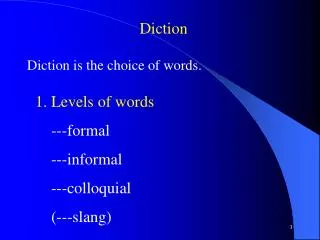
Devices • Latinate vs. Anglo Saxon Words • Latinate: Words derived from Latin; often longer and more flowery • Anglo Saxon: Words derived from German; often shorter and more informal • Examples: • Cognition vs. Thinking • Regal vs. Kingly
Devices • Formal vs. Informal Words • Think of Latinate vs. Anglo Saxon (very similar) • Use depends on audience • Differences: • Formal: Edify • Standard: Learn • Informal: Wise Up • Formal diction can give you credibility to a highly educated audience in very formal settings (sermons, scholarly journals, etc.) BUT can make you sound pretentious and stuffy in the wrong setting • Informal diction can make you seem approachable to a general audience BUT can damage your credibility with a more sophisticated audience
Devices • Jargon: Phrases or words used in a particular field or trade –very specific to an audience • In August 2008, 19 individuals brought a putative class action lawsuit in the U. S. District Court for the Northern District of California against Facebook and the companies that had participated in Beacon, alleging violations of various federal and state privacy laws. • Slang: Words that are not part of the standard vocabulary and are used informally • “Busy old fool, unruly Sun,Why dost thou thus,Through windows, and through curtains, call on us?Must to thy motions lovers’ seasons run?Saucy pedantic wretch” –John Donne
Devices • Dialect: The language used by the people of a specific area, class, district or any other group of people. • Involves the spelling, sounds, grammar and pronunciation used by a particular group of people • Walter: Reckon I have. Almost died first year I come to school and et them pecans — folks say he pizened ‘em and put ‘em over on the school side of the fence. –Harper Lee To Kill a Mockingbird