Using Cross Products
This lesson explores the concept of cross products in proportional relationships. When two ratios are equivalent, their cross products are equal. For example, the ratios 4:3 and 12:9 form a proportion since their cross products (12 x 3 and 9 x 4) yield the same result (36). Conversely, ratios such as 5:2 and 8:3 do not form a proportion due to differing cross products (16 and 15). Students will learn how to solve proportions by setting up equations using cross products and applying inverse operations to isolate variables.

Using Cross Products
E N D
Presentation Transcript
Using Cross Products Lesson 6-4
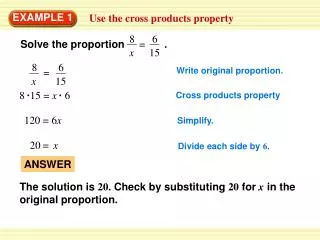
Cross Products • When you have a proportion (two equal ratios), then you have equivalent cross products. • Find the cross product by multiplying the denominator of each ratio by the numerator of the other ratio.
Example: Do the ratios form a proportion? Check using cross products. 4 3 , 12 9 These two ratios DO form a proportion because their cross products are the same. 12 x 3 = 36 9 x 4 = 36
Example 2 5 2 , 8 3 No, these two ratios DO NOT form a proportion, because their cross products are different. 8 x 2 = 16 3 x 5 = 15
Solving a Proportion Using Cross Products • Use the cross products to create an equation. • Solve the equation for the variable using the inverse operation.
Example: Solve the Proportion Start with the variable. 20 k = 17 68 Simplify. Now we have an equation. To get the k by itself, divide both sides by 68. 68k 17(20) = 68k = 340 68 68 k 5 =