Cloudy Thoughts
This exploration delves into the evolution of computing through cloud and grid technologies, tracing concepts from John McCarthy's vision of computational utilities to contemporary implementations such as Globus, TeraGrid, and OSG. It highlights how these innovations create an environment of infinite on-demand computing and storage, democratizing access for all. The significance of collaboration, data annotation, and automated maintenance is emphasized, alongside the unique business models emerging in this sphere. Discover the potential of these technologies for shaping the future of data analytics and resource allocation.

Cloudy Thoughts
E N D
Presentation Transcript
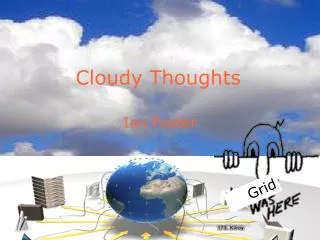
Cloudy Thoughts Ian Foster Grid
Is “Cloud” a New Concept? • “Computation may someday be organized as a public utility” – John McCarthy, 1960 • Project Mac • “By linking digital processors, storage systems and software on a global scale, grid technology is poised to transform computing from an individual and corporate activity into a general utility” – Scientific American, 2003 • Globus, TeraGrid, OSG, EGEE, … (& caBIG, ESG, …) • Infinite on-demand computing & storage to anyone with > $0.10 [where ∞ ≤ 100] • Primarily a business model innovation (?) [Search: “Ian Foster cloud” for further thoughts]
An Open Analytics Environment(or “Data Cauldron”) Programs & rules in Data in Resultsout • “No limits” • Storage • Computing • Format • Program • Allowing for • Versioning • Provenance • Collaboration • Annotation
What Goes In (2) Rules Parallel programs Swift MapReduce Workflows R Dryad MatLab SQL BPEL Octave SCFL
How it Cooks • Virtualization • Run any program, store any data • Indexing • Automated maintenance • Provisioning • Policy-driven allocation of resources to competing demands
Virtual Data Schema What Comes Out Data Data
Analysis as (Collaborative) Process Transform Annotate Search Add to Tag Visualize Discover Extend Group Share