Probing Metal Abundances in Star-Forming Regions: Insights from Blue Compact Dwarfs
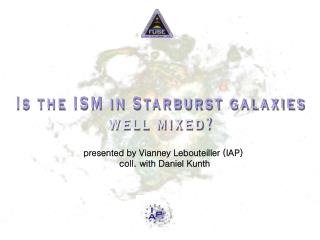
This study explores the metal abundances in star-forming regions, focusing on Blue Compact Dwarf Galaxies like IZw 18. We investigate the fate of metals produced in stars and their mixing within the interstellar medium (ISM). Employing optical, IR, and UV emission line spectroscopy, we analyze individual HII regions, address the lack of extremely metal-poor galaxies, and examine self-pollution effects from supernovae. Key findings emphasize the local enrichment of gas and the implications of ionization structure on metal distribution.

Probing Metal Abundances in Star-Forming Regions: Insights from Blue Compact Dwarfs
E N D
Presentation Transcript
Metal abundances in star-forming regionsThe puzzle V. Lebouteiller, D. Kunth
Mixing in the ISM • Fate of the metals produced in stars ? • Dispersion + mixing timescales • Starburst regions context The Blue Compact Dwarf Galaxy IZw 18 1/18
From the IR... • Optical, IR : emission line spectrum • Kunth & Sargent (1986) : lack of extremely metal-poor galaxies in surveys Self–pollution ? by fresh released metals in situ by SNe, providing rapid (few Myrs) cooling of the hot gas during the lifetime of the starburst 2/18
...to the UV Absorption line spectrum FUSE(NASA-CNES-ASC) + (HST/STIS, HST/GHRS, IUE, Copernicus, HUT) 900 Å • Res: ~0.07 Å • Resonant lines of : HI, OI, NI, FeII, SiII, ArI, ... 1200 Å 3/18
Probing the neutral gas + clouds of the Milky Way 4/18
Absorption Spectra analysis • Profile fitting procedure Owens (M. Lemoine, IAP) • returns most likely values • Owens derives an estimation of the errors • (including uncertainties on the LSF, the continuum,...) N , b, T • One single absorption line system • Deriving abundances from the column densities • ionization structure H N O Si P Ar Fe H I (13.60 eV) N I (14.53 eV) O I (13.62 eV) SiII (16.34 eV) P II (19.72 eV) Ar I (15.76 eV) FeII (16.18 eV) 5/18
Blue Compact Dwarfs HII region (opt. +IR em. lines) HI region (UV abs. lines) [N/H] [O/H] NGC1705 NGC253 IZw18 IZw36 Markarian59 SBS0335-052 [Si/H] [P/H] [Ar/H] [Fe/H] Refs :Lebouteiller et al. (2003), Lecavelier et al. (2003), Aloisi et al. (2003), Thuan et al. (2005), Thuan et al. (2002), Lee et al. (2003) 6/18
Individual HII regions in spiral galaxies M33 • Single HII region • Stellar population can be resolved Avoid possible systematic errors, study the effects of the multiple sightlines, ... Opportunity to model the ionization stucture, etc... 1’ 7/18
Far-UV spectra FUSE MDRS FUSE LWRS IUE FUSE LWRS HST/STIS HST/ STIS FUSE MDRS 20 pc Fig. : HST/STIS image at 2000 Å of NGC604, in M33 8/18
ISM analysis Pcygni CIII Pcygni OVI Wavelength (Å) Metals in NGC604 HI in NGC604 9/18
HIcontent • Radio, 21cm emission log N(HI)=21.1 • UV, 10 IUE spectra Lya • UV, STIS spectra towards ind. stars Lya • UV, STIS global spectrum Lya • UV, FUSE spectra Lyb HI in absorption (UV resonance lines) HI in emission (21cm, radio) 10/18
HI content • Radio, 21cm emission log N(HI)=21.1 • UV, 10 IUE spectra Lya 21.07±0.20 • UV, STIS spectra towards ind. stars Lya • UV, STIS global spectrum Lya • UV, FUSE spectra Lyb 11/18
HI content • Radio, 21cm emission log N(HI)=21.1 • UV, 10 IUE spectra Lya 21.07±0.20 • UV, STIS spectra towards ind. stars Lya • UV, STIS global spectrum Lya • UV, FUSE spectra Lyb 12/18
HI HI with STIS • Mean value = 20.84±0.23 • Flux-weighted mean = 20.77±0.27 selection effects no significant systematic errors Lyman a
HI content • Radio, 21cm emission log N(HI)=21.1 • UV, 10 IUE spectra Lya 21.07±0.20 • UV, STIS spectra towards ind. stars Lya 20.84±0.23 • UV, STIS global spectrum Lya 20.67±0.20 • UV, FUSE spectra Lyb 14/18
HI content • Radio, 21cm emission log N(HI)=21.1 • UV, 10 IUE spectra Lya 21.07±0.20 • UV, STIS spectra towards ind. stars Lya 20.84±0.23 • UV, STIS global spectrum Lya 20.67±0.20 • UV, FUSE spectra Lyb 20.75±0.20 15/18
Ionization effects CLOUDYphotoionization code Estimate column densities in the HII gas + dominant ionization state in the neutral gas 16/18
Comparison with ionized gas results Abundances consistent with O Global underabundance of N and the α-elements / solar (X/H neutral < X/H ionized) except Fe (depletion HII gas ?) O, Si, Ar in solar proportions N/O, Ar/O consistent HII/HI No depletion and ionization corrections for N, O, Si, and Ar 17/18
Discussion Confirmation on more solid grounds of the BCDs results • Local enrichment by a previous burst ? (timescale !) • Dilution by lower metallicity gas ? • Infalling halo or extragalactic gas • Photodissociation of H2 • HI in form of baryionic dark matter (dense cold clumps of primordial material) 18/18