Download
1 / 26
260 likes | 382 Vues
This chapter delves into the essential functions of the U.S. judicial branch, emphasizing the importance of equal justice under the law. It outlines the four types of laws in the U.S., explores the structure and roles of the federal court system, and highlights the Supreme Court's power of judicial review. The various cases tried in federal courts and the principles of citizenship and law-abiding conduct are discussed. Key questions focus on the roles of the courts and the impact of judicial decisions on American society and constitutional rights.

E N D
Chapter 7The Judicial Branch Section 1: Equal Justice Under the Law Section 2: The Federal Court System Section 3: The Supreme Court
Section 1: Equal Justice Under the Law The Main Idea The rights of all U.S. citizens are protected by laws and the courts. Reading Focus • In what ways is the United States a nation of laws? • What are the four sources of law in the United States? • What roles do the courts play in the United States?
Majority rule affects the making of laws. Section 1: Equal Justice Under the Law • Laws usually reflect the opinion of the majority. • Laws are passed for the good of all citizens. • Good citizenship involves abiding by the laws. • Without laws, anarchy could develop.
Four types of U.S. laws: Section 1: Equal Justice Under the Law • Statutory law—passed by lawmaking bodies • Common law—judges’ decisions based on common sense, experience, and practice • Administrative law—created by government agencies • Constitutional law—based on the Constitution and its interpretation by the Court
Role of the Courts in the United States Section 1: Equal Justice Under the Law • Use law to settle disputes • Assure equal justice for all through fair trials
The Roles that Courts Play provide fair public trials ensure equal justice for all SECTION 1 Question: What roles do the courts play in the United States?
Section 2: The Federal Court System The Main Idea The federal court system consists of the three levels of courts, each of which has specific duties. Reading Focus • What is the purpose of the U.S. district courts? • How are the U.S. courts of appeals different from the district courts? • What is the role of the Supreme Court?
Cases tried in the federal courts: Section 2: The Federal Court System • Cases involving people charged with disobeying the Constitution, violating a U.S. treaty, or breaking laws passed by Congress • Charges brought by a foreign country against the United States or its citizens • Crimes committed on U.S. ships at sea
Cases tried in the federal courts: (continued) Section 2: The Federal Court System • Ambassadors and consuls charged with breaking laws in a foreign country • Crimes committed on certain federal properties • Disagreements between the states • Lawsuits between citizens of different states
Organization of Federal Courts Section 2: The Federal Court System • Ninety-four district courts—at base of system; jury trials held here • Courts of Appeal—review district court cases; 12 courts of appeal cover circuits; panels of judges make the decisions • U.S. Supreme Court—highest court in the land; an appeals court; decisions are final
Role of the Supreme Court Section 2: The Federal Court System • Reviews cases from lower federal courts and state courts • Constitutional jurisdiction over: • cases involving diplomatic representatives from other countries • disputes between states • disputes between states and federal government
SECTION 2 Federal Court Cases Question: Which cases are tried in federal courts? • 1. constitutional violations • 2. U.S. treaty violations • 3. congressional law violations • 4. cases between a foreign government and a U.S. citizen or the government • 5. crimes committed on U.S. ships at sea • 6. cases involving U.S. ambassadors and consuls who broke laws in their stationed countries • 7. crimes committed on certain types of federal property • 8. disagreements between states or citizens of different states
Section 3: The Supreme Court The Main Idea The Supreme Court hears appeals, reviews laws, and strongly influences American society. Reading Focus • What is the power of the judicial review? • What are the constitutional checks on the Supreme Court’s powers? • How has the Supreme Court strengthened constitutional rights?
Process through which cases are tried in the Supreme Court: Section 3: The Supreme Court • Thousands of cases are appealed to the Court each year. • One hundred to 200 cases are selected for the docket. • Selected cases contain significant public interest or questions. • Four out of nine justices must vote to hear a case. • Previous verdicts stand for rejected cases.
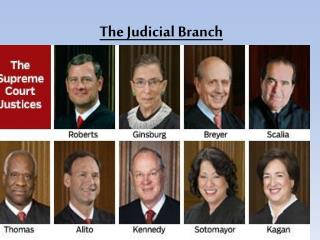
Supreme Court justices Section 3: The Supreme Court • Are appointed by the president and approved by a Senate majority vote. • Are appointed for life but may be impeached.
Judicial review has strengthened the Court’s power. Section 3: The Supreme Court • Courts decide if a law or presidential action is constitutional. • Supreme Court has the ultimate power of judicial review.
Congress can limit the Court’s power. Section 3: The Supreme Court • Can rewrite laws to make them constitutional • Can amend the Constitution to include new laws
Judicial Review Congress SECTION 3 Question: How has judicial review strengthened the Supreme Court’s power, and how does Congress limit this power? Limit Congress may pass a similar law abiding by the Constitution or may try to amend the Constitution. Strengthen It asserted the Court’s power to declare laws of Congress and presidential acts unconstitutional.
Chapter 7 Wrap-Up • 1. Describe the types of laws that exist in the United States. • 2. What services do U.S. courts provide? • 3. Which cases are tried in federal courts? • 4. How is the federal court system organized? • 5. How are appointments made to the Supreme Court, and how long do justices serve? • 6. How does the Supreme Court limit Congress’s power, and how does Congress reassert it?