Download
1 / 23
290 likes | 685 Vues
This document outlines key protocols for oxygen therapy initiation, monitoring, and safe handling in pediatric patients at Alberta Children’s Hospital. It emphasizes that oxygen (O2) is treated as a drug, requiring a physician's order for its use outside emergency situations. Proper humidification, device selection, and safe transport of O2 cylinders are critical. Additionally, it provides practical tips for managing O2 delivery in children, ensuring their comfort during treatment. Consistent monitoring and documentation are crucial for patient safety and effective therapy.

E N D
Oxygen Therapy Jennifer Oliverio RRT, BSc Clinical Educator Respiratory Services Alberta Children’s Hospital
O2 Initiation • O2 is a drug. A Dr.’s order is required to initiate O2 tx except in emergency situations • Order should include specific SpO2 or O2 flow rate/ FiO2 • O2 can be started without an order if hypoxia is suspected. Dr. must be contacted ASAP
Humidification • Standard wall set-up for O2 requires humidification (bubble humidifier/ cold neb) • Assess fluid level in humidifier with each RN assessment. Change 3x/week + prn • Portable O2 set-up: DO NOT incorporate humidity (risk of water spilling into delivery device)
Bubble Humidifier Use at flowrates < 10 LPM
Monitoring • O2 to be treated as a drug so need to ensure the rights: • Patient • Drug (O2) • Route (device) • Dose (flow/FiO2) • Documentation • Reason
Monitoring • Any changes to FiO2 or flow rate must be documented, including respiratory assessment • Dr. should be notified if previously stable pt exhibits respiratory instability or O2 needs exceed device
Safe Handling of O2 • Cylinders should be placed in secure holder to prevent tipping/ falling when not in use • When transporting pt on O2, cylinder must be secured in a carrier attached to bed, strecher, wheelchair or crib
Transporting pts on O2 • Ensure adequate O2 supply in tank for anticipated length of time • Switch to wall O2 if available at destination and TURN TANK OFF! • May need to bring 2 tanks for pt’s requiring high flow • Change cylinders at 500 psi
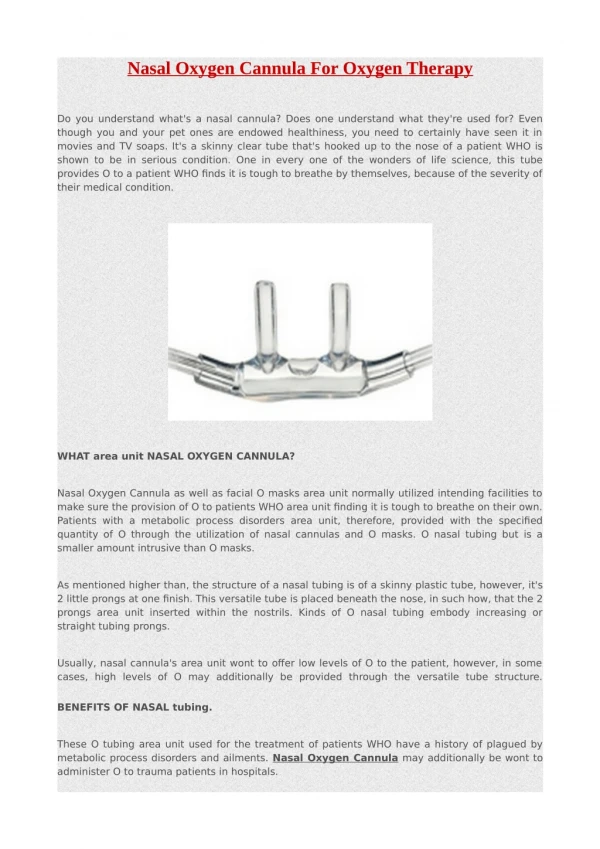
Devices • Nasal cannula • Simple O2 Mask • Non- rebreathing mask
Nasal Cannula • FiO2 0.22-0.40 • Prongs should not completely occlude the nares- multiple sizes available • **Ensure pt nares are patent** • Use with bubble humidifier
Simple O2 Mask • FiO2 0.35-0.50 • ****Minimum 5 LPM O2 flow!!!!****** • Can’t really titrate O2 • Pt can’t eat/ drink • Use with bubble humidifier • Gently press on metal bar to conform to pt’s face. Do NOT pinch!
Partial Non- Rebreathing Mask • FiO2 0.60-0.90 (depending on mask fit) • Minimum 5 LPM for infant/child, 10 LPM for teens. Match flow to need • Reservoir bag and one-way valve limit amount of RA inspired and ↓ dilution of FiO2 • Gently press on metal bar to conform to pt’s face. Do NOT pinch! • DO NOT USE WITH HUMIDITY
Helpful Tips • No child or infant likes strangers • No child or infant likes things on their face • If they are not upset with you putting on a mask or prongs be concerned! • You may need to have parents help you hold the child or you may need to bunny the child for a short time until they get used to the therapy
The Parent Hold • Place the child sideways across their lap with the child’s legs held between the parents legs. • Place the child’s arm closest to the parent behind the parent’s back • The parent can use one arm to hold the free arm of the child and the other hand to hold device in place/ or the child’s head still
Bunny • snuggly wrap a blanket around the arms and torso of the infant/child