Respiration & Fermentation Chapter 9
This chapter explores the crucial roles of mitochondria in cellular energy processes, detailing how glucose is broken down to produce ATP through aerobic and anaerobic pathways. It explains the significance of calories as a measure of energy and the processes of cellular respiration, including glycolysis, the Krebs cycle, and the electron transport chain. Additionally, it covers fermentation types: alcoholic and lactic acid, illustrating how they enable energy production without oxygen. Discover the efficiency of these processes in producing ATP and sustaining animal life.

Respiration & Fermentation Chapter 9
E N D
Presentation Transcript
Respiration & Fermentation • Chapter 9
Standard 1g • 1g: Students know the role of mitochondria in making stored chemical bond energy available to cells by completing the breakdown of glucose to carbon dioxide.
Calories • In order for animals to survive, they must eat food in order to obtain energy. • Energy is measured in calories • calorie: energy used to raise temperature of 1 gram of water 1 degree Celsius. • Calorie = 1000 calories • The main source of energy for animals is glucose. (3811 calories)
How animals make more batteries (ATP) • Animals use simple sugars like glucose to make ATP • Animals make the majority of the ATP in the mitochondria • There are two ways you can make ATP • With oxygen (aerobic) • Without oxygen (anaerobic)
ATP Section 8-1 Adenine Ribose 3 Phosphate groups Go to Section:
Figure 8-3 Comparison of ADP and ATP to a Battery Section 8-1 ADP ATP Energy Energy Adenosine diphosphate (ADP) + Phosphate Adenosine triphosphate (ATP) Partially charged battery Fully charged battery Go to Section:
Chemical Pathways Section 9-1 Glucose Krebs cycle Electrontransport Glycolysis Alcohol or lactic acid Fermentation (without oxygen) Go to Section:
Respiration: An Overview Mitochondrion Electrons carried in NADH Electrons carried in NADH and FADH2 Pyruvic acid Glucose Electron Transport Chain Krebs Cycle Glycolysis Mitochondrion Cytoplasm Go to Section:
Glycolysis Glucose 2 Pyruvic acid To the electron transport chain Go to Section:
Glycolysis Glucose 2 Pyruvic acid To the electron transport chain Go to Section:
Glycolysis Glucose 2 Pyruvic acid To the electron transport chain Go to Section:
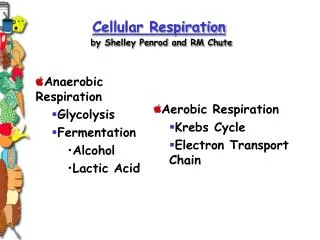
Anaerobic (without oxygen) • Anaerobic = Fermentation • Two types • Lactic Acid Fermentation (occurs in animals) • Alcohol Fermentation (occurs in plants and simple organisms) • Both types of fermentation start with glucose and both end with the production of ATP
2ADP + 2 2ATP C C C C CC P 2NADH 2 NAD+ C C C C C Glycolysis 2 Ethanol 2 Pyruvic acid 2CO2 released 2 NAD+ 2NADH glucose Alcohol Fermentation • Pyruvic acid + NADH alcohol + CO2 + NAD+ • Plants and Fungi beer and wine
Alcohol Fermentation • End Products: Alcohol fermentation • 2 - ATP • 2 - CO2 • 2 - Ethanol’s
Lactic Acid Fermentation Lactic acid Glucose Pyruvic acid Go to Section:
Lactic Acid Fermentation Lactic acid Glucose Pyruvic acid Go to Section:
Lactic Acid Fermentation Section 9-1 Lactic acid Glucose Pyruvic acid Go to Section:
2ADP + 2 2ATP C C C C CC P 2NADH 2 NAD+ C C C C C C Glycolysis 2 Lactic acid 2 Pyruvic acid 2 NAD+ 2NADH Glucose Lactic Acid Fermentation • Pyruvic acid + NADH lactic acid + NAD+ • Animals (pain in muscle after a workout).
Lactic Acid Fermentation • End Products: Lactic acid fermentation • 2 - ATP • 2 - Lactic Acids • OW! My muscles ache!
Aerobic (need oxygen) • Respiration = Cellular Respiration = Aerobic Respiration = all describe the same thing • Reactants • Glucose • Oxygen • ADP + P • Products • Carbon dioxide • Water • ATP
glucose ATP Cellular Respiration – “The Simplified Equation” • An oxygen (O2)requiring process that uses energyfrom carbohydrates (glucose) to produce energy (ATP)and water (H2O) and carbon dioxide. • C6H12O6 + 6O2 6CO2 + 6H2O + energy
Flowchart Section 9-2 Cellular Respiration Glucose(C6H1206) + Oxygen(02) Glycolysis KrebsCycle (Citric acid Cycle) ElectronTransportChain Carbon Dioxide (CO2) + Water (H2O) Go to Section:
Citric Acid Production Mitochondrion The Krebs Cycle Go to Section:
The Krebs Cycle Citric Acid Production Mitochondrion Go to Section:
Electron Transport Chain Electron Transport Hydrogen Ion Movement Channel Mitochondrion Intermembrane Space ATP synthase Inner Membrane Matrix ATP Production Go to Section:
RESPIRATION 1 glucose molecule Produces 38 ATP Net 36 ATP FERMENTATION 1 glucose molecule Produces 4 ATP Net 2 ATP You want to make batteries for future use. Which process efficiently produces ATP? Comparison of ATP production between respiration and fermentation