Impact of Agricultural and Industrial Practices on Dissolved Oxygen Levels in Aquatic Ecosystems
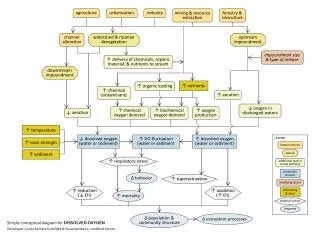
This study explores the interrelated effects of urbanization, industrial activities, and agricultural practices on dissolved oxygen (DO) levels within watershed and riparian environments. It examines how impoundment, chemical contaminants, and changes in land use affect oxygen production and biochemical oxygen demand (BOD). Key findings include the influence of temperature, organic loading, and sediment composition on dissolved oxygen fluctuations, indicating significant implications for aquatic life and ecosystem health. The research provides a conceptual framework for understanding these complex interactions.

Impact of Agricultural and Industrial Practices on Dissolved Oxygen Levels in Aquatic Ecosystems
E N D
Presentation Transcript
agriculture urbanization industry downstream impoundment watershed & riparian devegetation upstream impoundment forestry & silviculture mining & resource extraction human activity ↓ oxygen in discharged waters channel alteration ↑ chemical contaminants ↑ oxygen production ↑ biochemical oxygen demand ↑ delivery of chemicals, organic material, & nutrients to stream ↑ chemical oxygen demand ↑ aeration ↑ organic loading ↓ aeration ↑ nutrients additional step in causal pathway source impoundment size & type of release modifying factor ↑ temperature ↑ ionic strength LEGEND ↑ sediment ↓ dissolved oxygen (water or sediment) ↑ DO fluctuation (water or sediment ↑ dissolved oxygen (water or sediment) ↑ supersaturation ↑ respiratory stress proximate stressor mode of action ↑ oxidation (↑ Eh) ↑ reduction (↓ Eh) interacting stressor response Simple conceptual diagram for DISSOLVED OXYGEN Developed 7/2007 by Kate Schofield & Suzanne Marcy; modified 6/2010 ↑ mortality ∆ behavior ∆ ecosystem processes ∆ population & community structure