Implicit Association Test
The Implicit Association Test (IAT) is designed to uncover unconscious preferences through classification tasks, examining the strength of automatic associations. This research investigates Thai university students' implicit and explicit attitudes toward native English speaker teachers (NESTs) and non-native English speaker teachers (non-NESTs). By comparing these attitudes and their relationship to prior learning experiences, the study aims to shed light on students' perceptions and biases in language education. Explore IAT further at: [implicit.harvard.edu](https://implicit.harvard.edu).

Implicit Association Test
E N D
Presentation Transcript
Implicit Association Test July 15, 2010 PunjapornPojanapunya punjaporn.poj@kmutt.ac.th
Speak your mind • Can you speak your mind? • Do you know your mind? Questionnaire Implicit Association Test (IAT)
Implicit Association Test • Assess your unconscious preferences using Implicit Association Test • ‘‘a measure of strengths of automatic associations” which examines performance speeds on classification tasks (Greenwald et al., 2003, p. 197)
Implicit Association Test Concepts - Attributes Source: https://implicit.harvard.edu/implicit/demo/selectatest.html
Implicit Association Test This IAT often reveals a relative link between: • Liberal arts & Females • Science & Males Concepts - Attributes Gender – Science IAT Source: https://implicit.harvard.edu/implicit/demo/selectatest.html
Implicit Association Test Male Science Female Liberal Arts Man Girl Humanities Biology
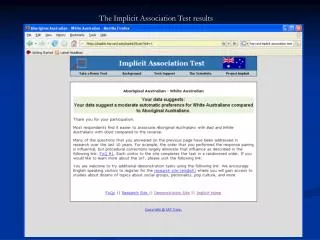
Implicit Association Test • More IAT: https://implicit.harvard.edu/implicit/demo/selectatest.html https://implicit.harvard.edu/implicit/thailand
IAT research • Implicit attitudes towards native and non-native speaking teachers • Implicit attitudes: IAT • Explicit attitudes: preferences and feelings • Watson Todd, R. and Pojanapunya, P., 2009, Implicit attitudes towards native and non-native speaker teachers, System, Vol. 37, No.1, pp. 23-33.
IAT research • RQs: • What are Thai university students’ explicit attitudes towards NESTs and non-NESTs? • What are Thai university students’ implicit attitudes towards NESTs and non-NESTs? • Is there a relationship between explicit and implicit attitudes towards NESTs and non-NESTs? • Is there a relationship between previous learning experience with NESTs and attitudes towards NESTs and non-NESTs?
IAT research This IAT often reveals a relative link between: • NESTs & positive • non-NESTs & negative Concepts - Attributes Native Teachers ? ?
IAT research:Explicit attitudes (questionnaire) • Have you ever experienced native English speaker teachers? • In your educational experience, how much did you like studying English with native and non-native English speaker teachers (NESTs and non-NESTS)? • I would want to be taught English by a NEST • I would want to be taught English by a non-NEST • Suppose that 10 English teachers were recruited. How many of them do you think would be NESTs and non-NESTS? • Please rate how warm or cold you feel toward NESTs and non-NESTS? (0 = coldest feelings, 5 = neutral, 10 = warmest feelings)
Try IAT • Implicit attitudes towards native and non-native speaking teachers • http://arts.kmutt.ac.th/crs/moodle/instruction.html
Data analysis • RQs: • What are Thai university students’ explicit attitudes towards NESTs and non-NESTs? • What are Thai university students’ implicit attitudes towards NESTs and non-NESTs? • Is there a relationship between explicit and implicit attitudes towards NESTs and non-NESTs? • Is there a relationship between previous learning experience with NESTs and attitudes towards NESTs and non-NESTs? • Mean, SD, T-test, correlation
IAT & research in SoLA • Social Science • Smoking: smokers and non-smokers • Social imbalance: Isarn and Central Thai • Language studies • Dictionaries: electronic and paper dictionaries • Graded readers: reading in English and reading in Thai
SoLA funding • Budget • Programmer • Minor-cost project funding • Proposals • can be submitted by full-time staff of SoLA • can be submitted at any time to the CRS • can ask for funding up to a maximum of 5,000 baht • should include the following information: researcher's name, title of research project, concise (1 paragraph) description of the project, and details of budget required Source: http://arts.kmutt.ac.th/crs/