Road to Independence: From Washington's Army to Declaration Signing
190 likes | 297 Vues
Explore the beginning of the American Revolution, from George Washington leading the Continental Army to the signing of the Declaration of Independence, highlighting pivotal events and key figures.


Road to Independence: From Washington's Army to Declaration Signing
E N D
Presentation Transcript
The Declaration of Independence Chapter 6
War Begins • George Washington and the Continental Army • 1. John Adams proposed a “Continental Army” made up of troops from all colonies • George Washington of Virginia elected as Commander-in-Chief of the “Continental Army”
War Begins • The Battle of Bunker Hill • 1. Started when Minutemen erected small fort atop Breed’s Hill in Boston • 2. Worried British General Howe ordered immediate attack • a. Marched 2,000 soldiers up hill • b. Minutemen ordered not to fire until they “saw the whites of their eyes” • c. Caught off guard, British regrouped and attacked again • d. British took hill on 3rd attack after Americans used up gunpowder • e. Misnamed Battle of Bunker Hill – killed 1,000 British and 500 Americans
Siege of Boston • Ticonderoga • 1. Washington learned army had only 36 barrels of gunpowder • a. Deceived British by writing false letter claiming to have 1,800 barrels • b. Begged the colonies for more gunpowder • 2. Sent Henry Knox to Fort Ticonderoga for larger artillery • a. Loaded 59 cannons onto sled and dragged them 300 miles to Boston • b. Another 42 sleds carried 2,300 lbs of lead for bullets
Siege of Boston • British Abandon Boston • 1. March 4, 1776 – British awoke to cannons aimed at city • 2. British abandoned – 100+ ships left harbor and headed to Canada carrying 9,000 troops and 1,100 Loyalists
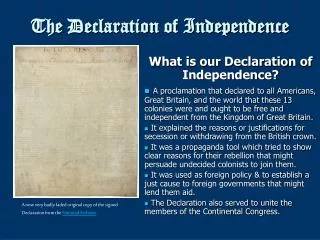
Toward Independence • Olive Branch Petition • 1. July 1775 – Congress sent petition to king asking him to end quarrel • 2. By time petition reached King George, he declared Colonies to be in “Open and avowed rebellion”
Toward Independence • Common Sense (by Thomas Paine, 1776) • A Pamphlet that mocked the idea that Americans owed any loyalty to king • Attacked argument that colonies’ties to Britain benefited Americans • 3. Persuaded Americans that independence was sensible and the “key to a brighter future”
“We must all hang together. Or most assuredly we shall all hang separately.” - Benjamin Franklin
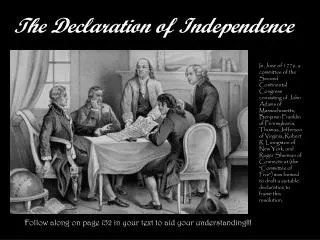
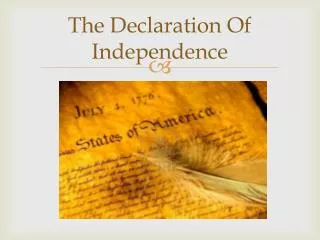
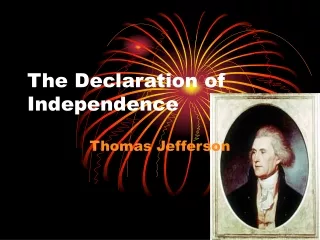
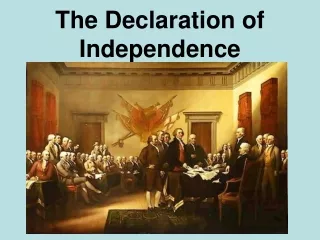
Thomas Jefferson Drafts a Declaration • Committee Appointed • 1. To write formal declaration of independence explaining why the colonies chose to separate from Britain • Natural Rights • 1. All people born equal in God’s sight and are entitled to same basic rights • 2. Governments formed to secure those rights with the power to rule coming from the governed • 3. Failure to protect rights = new government • King’s Crimes • 1. King’s policies established tyranny over colonies • 2. Long list of king’s abuses – unfit to be a ruler of free people
Thomas Jefferson Benjamin Franklin John Adams
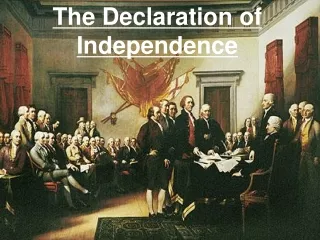
The Final Break • Second Continental Congress • 1. Philadelphia, July 1, 1776 Met to debate independence • Debate Over Slavery • 1. Most delegates liked Jefferson’s declaration except for passage on slavery • a. Southerners feared it might lead to demands to • free the slaves • b. Northerners worried that New England merchants • who profited from slave trade might be offended • c. Even those who opposed slavery felt it wrong to • blame king for enslaving Africans • Independence Day • 1. Final version approved on July 4 • 2. Pledged to support independence with their lives, fortunes and honor • 3. Act of treason against Britain and failure = hanging
“We must all hang together. Or most assuredly we shall all hang separately.” - Benjamin Franklin