Understanding Water's Amphiprotic Nature and Its Role in Acid-Base Chemistry
Water is a unique substance that can behave as both an acid and a base, allowing it to donate and accept protons. This dual behavior is due to its ability to dissociate into H+ (hydronium ions, H3O+) and OH- ions. Substances that demonstrate both acid and base characteristics are termed amphiprotic, while those that can react with acids or bases are described as amphoteric. Understanding these concepts is fundamental in chemistry, particularly in reaction rates, equilibrium, and the behavior of acidic and basic solutions.

Understanding Water's Amphiprotic Nature and Its Role in Acid-Base Chemistry
E N D
Presentation Transcript
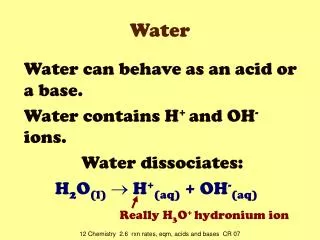
Water • Water can behave as an acid or a base. • Water contains H+ and OH- ions. • Water dissociates: • H2O(l) H+(aq) + OH-(aq) • Really H3O+ hydronium ion 12 Chemistry 2.6 rxn rates, eqm, acids and bases CR 07
Amphiprotic vs amphoteric • A substance that can donate or accept protons is called amphiprotic • Salts can act as acids and bases by donating or accepting H+- usually H3O+ or OH- ions are formed – this is called amphoteric 12 Chemistry 2.6 rxn rates, eqm, acids and bases CR 07
acid base • HCl + H2O H3O+ + Cl- • Wateris behaving as a base accepts proton donates proton 12 Chemistry 2.6 rxn rates, eqm, acids and bases CR 07
base acid • O2- + H2O OH- • Wateris behaving as an acid accepts proton donates proton 12 Chemistry 2.6 rxn rates, eqm, acids and bases CR 07
Amphiprotic • Water is amphiprotic as it does not react with acids or bases to neutralise them – it does however donate or accept protons. • An amphoteric substance can neutralise an acid or a base 12 Chemistry 2.6 rxn rates, eqm, acids and bases CR 07
Acidic substances • When [H3O+] > [OH-] a solution is acidic • An acidic substance is a substance that will either: • dissolve in water to form an acidic solution OR • Do not dissolve but react with bases and basic solutions 12 Chemistry 2.6 rxn rates, eqm, acids and bases CR 07
Basic substances • When [OH-]> [H3O+] a solution is basic • A basic substance is a substance that will either: • dissolve in water to form a basic solution OR • Do not dissolve but react with acids and acidic solutions 12 Chemistry 2.6 rxn rates, eqm, acids and bases CR 07
Amphoteric substances • Amphoteric substances do not dissolve in waterBUTdo react with BOTHacidic and basic solutions. • Metal oxides and hydroxides are amphoteric 12 Chemistry 2.6 rxn rates, eqm, acids and bases CR 07
Al2O3 is amphoteric • Al2O3(s)+6H+(aq)2Al3+(aq) +3H2O(aq) • Al2O3(s)+2OH-(aq)+3H2O 2Al(OH)4(aq) +3H2O(aq) • evaporated NaAl(OH)4 • Al2O3(s) has reacted with both an acidic solution and a basic solution 12 Chemistry 2.6 rxn rates, eqm, acids and bases CR 07