Classical scheduling algorithms for periodic systems
This course explores classical scheduling algorithms in the context of periodic systems, including rate-monotonic scheduling for independent tasks and hardware/software partitioning for dependent tasks. It covers methodologies such as design space exploration and the use of genetic algorithms to optimize scheduling in heterogeneous systems. Additionally, practical insights are provided through guest lectures from industry experts, addressing the complexities of embedded systems and real-time operating systems.

Classical scheduling algorithms for periodic systems
E N D
Presentation Transcript
Classical scheduling algorithmsfor periodic systems Peter Marwedel TU Dortmund, Informatik 12 Germany 2007/12/14
Structure of this course guest lecture on multisensor systems (Fink) New clustering 3: Embedded System HW 5: Scheduling,HW/SW-Partitioning, Applications to MP-Mapping 2: Specifications 8: Testing Application Knowledge 4: Standard Software, Real-Time Operating Systems 7: Optimization of Embedded Systems 6: Evaluation guest lecture from industry (NXP) [Digression: Standard Optimization Techniques (1 Lecture)] guest lecture on (RT-) OS (Spinczyk)
Classes of mapping algorithmsconsidered in this course • Classical scheduling algorithmsMostly for independent tasks & ignoring communication, mostly for mono- and homogeneous multiprocessors • Hardware/software partitioningDependent tasks, heterogeneous systems,focus on resource assignment • Dependent tasks as considered in architectural synthesisInitially designed in different context, but applicable • Design space exploration using genetic algorithmsHeterogeneous systems, incl. communication modeling
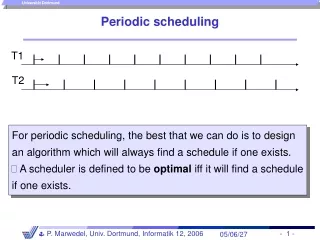
Periodic scheduling • For periodic scheduling, the best that we can do is to design an algorithm which will always find a schedule if one exists. A scheduler is defined to be optimal iff it will find a schedule if one exists. T1 T2
Periodic scheduling • Let • pi be the period of task Ti, • ci be the execution time of Ti, • dibe the deadline interval, that is, the time between a job ofTi becoming available and the time until the same job Ti has to finish execution. • ℓi be the laxity or slack, defined asℓi= di - ci pi di ci ℓi
Accumulated utilization • Accumulated utilization: Necessary condition for schedulability(with m=number of processors):
Independent tasks:Rate monotonic (RM) scheduling • Most well-known technique for scheduling independent • periodic tasks [Liu, 1973]. • Assumptions: • All tasks that have hard deadlines are periodic. • All tasks are independent. • di=pi, for all tasks. • ci is constant and is known for all tasks. • The time required for context switching is negligible. • For a single processor and for n tasks, the following equation holds for the accumulated utilization µ:
Rate monotonic (RM) scheduling- The policy - RM policy: The priority of a task is a monotonically decreasing function of its period. At any time, a highest priority task among all those that are ready for execution is allocated. Theorem: If all RM assumptions are met, schedulability is guaranteed.
Maximum utilization for guaranteed schedulability Maximum utilization as a function of the number of tasks:
Example of RM-generated schedule T1 preempts T2 and T3. T2 and T3 do not preempt each other.
Case of failing RM scheduling Task 1: period 5, execution time 2 Task 2: period 7, execution time 4 µ=2/5+4/7=34/35 0.97 2(21/2-1) 0.828 Missing computations scheduled in the next period Missed deadline
Intuitively: Why does RM fail ? No problem if p2 = m p1, mℕ : Switching to T1 too early, despite early deadline for T2 T1 t T2 should be completed T1 fits t T2 leviRTS animation
Morein-depth: Proof of RM optimality • Definition: A critical instant of a task is the time at which the release of a task will produce the largest response time. • Lemma: For any task, the critical instant occurs if that task is simultaneously released with all higher priority tasks. • Proof: Let T={T1, …,Tn}: periodic tasks with i: pi ≦ pi +1. Source: G. Buttazzo, Hard Real-time Computing Systems, Kluwer, 2002
Critical instances (1) • Response time of Tn is delayed by tasks Tiof higher priority: Tn Ti t cn+2ci • Delay may increase if Ti starts earlier Tn Ti t cn+3ci • Maximum delay achieved if Tn and Ti start simultaneously.
Critical instances (2) • Repeating the argument for all i = 1, … n-1: • The worst case response time of a task occurs when it is released simultaneously with all higher-priority tasks. q.e.d. • Schedulability is checked at the critical instants. • If all tasks of a task set are schedulable at their critical instants, they are schedulable at all release times.
The case i:pi+1 = mi pi • Lemma*: If each task period is a multiple of the period of the next higher priority task, then schedulability is also guaranteed if µ 1. • Proof: Assume schedule of Ti is given. Incorporate Ti+1: Ti+1 fills idle times of Ti; Ti+1 completes in time, if µ 1. Ti Ti+1 t T’i+1 Used as the higher priority task at the next iteration. * wrong in the book
Proof of the RM theorem • Let T={T1, T2} with p1 < p2. • Assume RM is notused prio(T2) is highest: p1 T1 c1 T2 t c2 • Schedule is feasible if c1+c2≦ p1 (1) • Define F= p2/p1: # of periods of T1fully contained in T2
Case 1: c1p2 – Fp1 • Assume RM is used prio(T1) is highest: • Case 1*: c1p2 – Fp1(c1 small enough to be finished before 2nd instance of T2) T1 T2 t Fp1 p2 • Schedulable if (F+1) c1 + c2p2 (2) * Typos in [Buttazzo 2002]: < and mixed up]
Proof of the RM theorem (3) • Not RM: schedule is feasible if c1+c2p1 (1) • RM: schedulable if (F+1) c1 + c2p2 (2) • From (1): Fc1+Fc2Fp1 • Since F 1: Fc1+c2 Fc1+Fc2Fp1 • Adding c1: (F+1)c1+c2 Fp1 +c1 • Since c1p2 – Fp1: (F+1)c1+c2 Fp1 +c1 p2 • Hence: if (1) holds, (2) holds as well • For case 1: Given tasks T1 and T2 with p1 < p2, then if the schedule is feasible by an arbitrary (but fixed) priority assignment, it is also feasible by RM.
Case 2: c1>p2 – Fp1 • Case 2: c1>p2 – Fp1(c1 large enough not to finish before 2nd instance of T2) T1 T2 t Fp1 p2 • Schedulable if F c1 + c2F p1 (3) • c1+c2p1 (1) • Multiplying (1) by F yields Fc1+ F c2Fp1 • Since F 1: Fc1+ c2 Fc1+ Fc2Fp1 • Same statement as for case 1.
Calculation of the least upper utilization bound • Let T={T1, T2} with p1 < p2. • Proof procedure: compute least upper bound Ulup as follows • Assign priorities according to RM • Compute upper bound Uup by setting computation times to fully utilize processor • Minimize upper bound with respect to other task parameters • As before: F= p2/p1 • c2 adjusted to fully utilize processor.
Case 1: c1p2 – Fp1 • Largest possible value of c2 is c2= p2 – c1 (F+1) • Corresponding upper bound is T1 T2 t Fp1 p2 { } is <0 Uub monotonically decreasing in c1 Minimum occurs for c1 = p2 – Fp1
Case 2: c1p2 – Fp1 • Largest possible value of c2 is c2= (p1-c1)F • Corresponding upper bound is: T1 T2 t Fp1 p2 { } is 0 Uub monotonically increasing in c1 (independent of c1 if {}=0) Minimum occurs for c1 = p2 – Fp1, as before.
Utilization as a function of G=p2/p1-F • For minimum value of c1: Since 0 G< 1: G(1-G) 0 Uub increasing in F Minimum of Uub for min(F): F=1
end Proving the RM theorem for n=2 • This proves the RM theorem for the special case of n=2
Properties of RM scheduling • RM scheduling is based on static priorities. This allows RM scheduling to be used in standard OS, such as Windows NT. • No idle capacity is needed if i: pi+1=F pi: i.e. if the period of each task is a multiple of the period of the next higher priority task, schedulability is then also guaranteed if µ 1. • A huge number of variations of RM scheduling exists. • In the context of RM scheduling, many formal proofs exist.
EDF • EDF can also be applied to periodic scheduling. • EDF optimal for every period • Optimal for periodic scheduling • EDF must be able to schedule the example in which RMS failed.
Comparison EDF/RMS • RMS: EDF: T2 not preempted, due to its earlier deadline. EDF-animation
EDF: Properties • EDF requires dynamic priorities • EDF cannot be used with a standard operating system just providing static priorities.
Sporadic tasks • If sporadic tasks were connected to interrupts, the execution • time of other tasks would become very unpredictable. • Introduction of a sporadic task server,periodically checking for ready sporadic tasks; • Sporadic tasks are essentially turned into periodic tasks.
Dependent tasks • Strategies: • Add resources, so that scheduling becomes easier • Split problem into static and dynamic part so that only a minimum of decisions need to be taken at run-time. • Use scheduling algorithms from high-level synthesis The problem of deciding whether or not a schedule existsfor a set of dependent tasks and a given deadlineis NP-complete in general [Garey/Johnson].
Summary • Periodic scheduling • Rate monotonic scheduling • Proof of the utilization bound for n=2. • EDF • Dependent and sporadic tasks (briefly)