Hindi greetings and basic expressions
hindi

Hindi greetings and basic expressions
E N D
Presentation Transcript
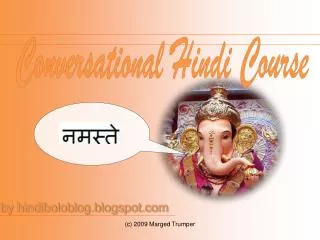
Conversational Hindi Course by hindiboloblog.blogspot.com (c) 2009 Marged Trumper
Greetings and other common expressions ‘Hello’, ‘Bye’ (c) 2009 Marged Trumper
Greetings namaste The most common way to greet someone in Hindi is namaste, this greeting comes from the Sanskrit namah + te that literally meant ‘honour to you’. Commonly, it is used addressing the person greeated with the respectful jī, as in namaste jī, namaste Mohan jī. This greeting is used with the meaning both of ‘hello’ and ‘good bye’. Namaskār is also a common greeting slightly more formal than namaste. Both namaste and namaskar are usually spoken while joining hands and slightly bending in a small bow. Originally, Hindi does not have greetings related to the times of the day, but some expressions corresponding to ‘good morning’ and ‘good night’ were introduced, but they are not so commonly used in the current language. Other ways to greet someone in Hindi are related to their religion. Sikh people use sat sirī akāl, Muslims salām alaikum and Hindus may use rām-rām or hari om. A very respectful way to greet elders is praṇām with a bow and touching their feet seeking their blessings. Back to lesson… (c) 2009 Marged Trumper
अ /a (c) 2009 Marged Trumper
Greetings namaskār Back to lesson… (c) 2009 Marged Trumper
Greetings and other common expressions ‘How are you?’ (c) 2009 Marged Trumper
Greetings kaise haiṃ? kaisī haiṃ? Variations: āp kaise haiṃ? āp kaisī haiṃ? Conversational Hindi often drops personal pronouns, while written Hindi doesn’t. In colloquial Hindi it is common to hear the grammatically incorrect expression āp kaise ho? Especially from Punjabi speakers, beacause it is a Punjabi form. The standard correct Hindi is āp kaise haiṃ, thus it’s better to stick to it, even if you are speaking with someone who uses that form. Back to lesson… (c) 2009 Marged Trumper
Greetings kaise ho? kaisī ho? Variations: tum kaise ho? tum kaisī ho? The formal āp haiṃ is safer to use with strangers, in case you can always switch to the informal tum ho if requested and if you feel comfortable with it, but avoid using it first as it might sound not very polite. Back to lesson… (c) 2009 Marged Trumper
Greetings and other common expressions ‘How is it going?’ (c) 2009 Marged Trumper
Greetings kyā hāl hai? Literally: how is the situation? Variations: tumhāra/āpkā kyā hāl hai? tumhāre/āpke kyā hāl haiṃ? tumhāra/āpka kyā hālchāl hai? A very informal colloquial variation is kyā chal rahā hai? Back to lesson… (c) 2009 Marged Trumper
Greetings and other common expressions ‘I’m fine!’ (c) 2009 Marged Trumper
अ /a (c) 2009 Marged Trumper
Greetings maiṃ ṭhīk hūṃ Back to lesson… (c) 2009 Marged Trumper
अ /a (c) 2009 Marged Trumper
Greetings maiṃ achchhī hūṃ feminine maiṃ achchhā hūṃ masculine Back to lesson… (c) 2009 Marged Trumper
Greetings and other common expressions ‘It’s fine!’ (c) 2009 Marged Trumper
Greetings ṭhīkhai Variation: ṭhīk-thāk hai This epression is very common and it also means ‘ok’, ‘it’s ok’ Back to lesson… (c) 2009 Marged Trumper
Greetings and other common expressions ‘Good’, ‘Really?’ by hindiboloblog.blogspot.com (c) 2009 Marged Trumper
अ /a (c) 2009 Marged Trumper
Greetings achchhā Back to lesson… (c) 2009 Marged Trumper
Greetings and other common expressions ‘Thank you’ by hindiboloblog.blogspot.com (c) 2009 Marged Trumper
Greetings dhanyavād shukriyā dhanyavād derives from Sanskrit, while shukriyā derives from Arabic through Urdu, thus it is used in more informal contexts. Anyway, in Hindi, the words for ‘thank you’ are not used as in English and other Western languages, because the use of polite forms already implies politeness. Such words are thus not used in everyday interaction, but when genuine gratitude has to be expressed. Back to lesson… (c) 2009 Marged Trumper
Greetings and other common expressions ‘Not at all’, ‘You are welcome’ (c) 2009 Marged Trumper
Greetings koī bāt nahīṃ Literally means: ‘it’s nothing’, (āpkā/tumhārā)svāgat hai, a corresponding expression for ‘you are welcome’ is also heard. Back to lesson… (c) 2009 Marged Trumper
Greetings and other common expressions ‘Excuse me!’ by hindiboloblog.blogspot.com (c) 2009 Marged Trumper
Greetings suniye Literally means: ‘please, listen’. Back to lesson… (c) 2009 Marged Trumper
अ /a (c) 2009 Marged Trumper
Greetings suno Back to lesson… (c) 2009 Marged Trumper
Greetings and other common expressions ‘Sorry’ by hindiboloblog.blogspot.com (c) 2009 Marged Trumper