Viruses
Viruses. To Live or Not To Live. Characteristics of Life. Composed of Cells Maintain Homeostatis Reproduce Respond To Stimuli. Characteristics of Life. Grow Use Energy Adapt and Evolve. Viruses. A virus can survive for hours on surfaces.

Viruses
E N D
Presentation Transcript
Viruses To Live or Not To Live
Characteristics of Life • Composed of Cells • Maintain Homeostatis • Reproduce • Respond To Stimuli
Characteristics of Life • Grow • Use Energy • Adapt and Evolve
Viruses • A virus can survive for hours on surfaces. • A virus cannot reproduce until it has a host. • It takes over the hosts cells. • The cell ruptures to release more viruses.
Living or Not Living • Small microbes composed of genetic material surrounded by a protein coat • They have no cytoplasm or internal metabolism. • They cannot grow or divide. • Require a host to reproduce.
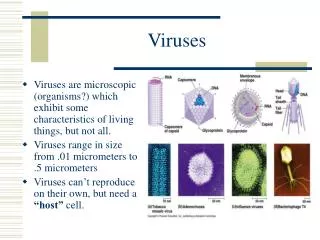
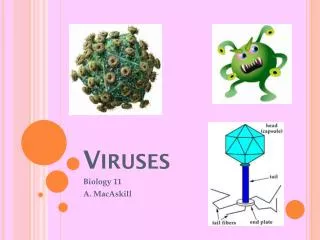
Viral Characteristics • 20 – 250 nanometers (1 centimeter = 10 million nanometers). • Thousands of different shapes, including: • Helical • Polyhedrons • Spheres • Complex (Binal)
Viral Structure • Core made of nucleic acid • DNA or RNA enclosed in a shell, called a capsid. • The proteins in the capsid determines the shape and the type of cell to be invaded. • The nucleic acid supplies the instructions for making the protein coat and replication.
Viral Structure • Some, like influenze, have an envelope. • The envelope is made of glycoproteins and lipids. • Glycoproteins help the virus gain entry into host cells. • Antigens are spikelikeextentions used to identify, attack and enter a host.
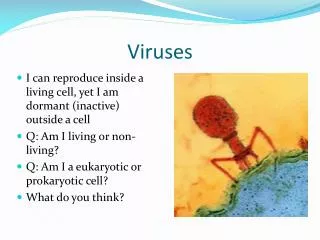
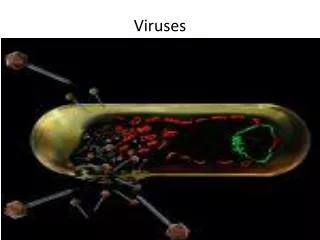
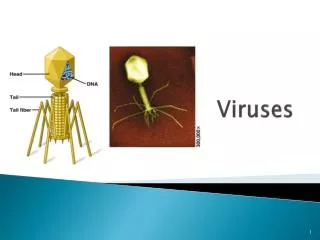
Viral Structure • Viruses that invade bacterial are called bacteriophages, like T-bacteriophage. • Genetic material is located in the capsid. • The tail fibers ID the cell and attach to the cell wall. • Enzymes in the tail fiber break down the host cell wall. • The tail sheath contacts and injects the DNA.
Viral Attachment • Infect based on “lock and key” (capsid - receptor) • Virsuses recognize cell surface markers • When the virus attaches itself, infection begins
Any Cell? • Every form, plants and fungi to animals and bacteria • However, not every cell • Plant virus cannot infect an animal cell • A virus for birds cannot infect a pig cell • However, mutations can occur
Lytic Cycle (Example: Influenze) • Trick or inject its genetic material • Take over the host DNA • Use the host enzymes to make viral DNA and parts • Viral parts assemble • Host cell fills up with viruses and lyses
Lysogenic Cycle(Example: HIV) • Inject into the host cell • Fuse with host DNA, forming viral genes • Host cell continues on normally, creating more infected cells • The environment triggers the virus to go active • Viral parts are made • Viruses can either released safely or build up and burst the host.
Beneficial • Used in genetic engineering • Splice in a “good gene” • Replaces faulty or missing genes • Use in agriculture to control pests
Bib • http://www.youtube.com/watch?v=rzdwfwuVWUU&feature=related • http://www.youtube.com/watch?v=ifudjnFjFQc