Comprehensive Guide to Intrauterine Contraceptive Devices (IUCD)
Learn about the types, advantages, disadvantages, indications, complications, insertion techniques, and patient selection criteria of IUCDs. Explore various IUCD generations, including copper and hormone-releasing devices. Discover the MOA, advantages, and disadvantages of Levonorgestrel and Progestasart devices.

Comprehensive Guide to Intrauterine Contraceptive Devices (IUCD)
E N D
Presentation Transcript
IUCD Dr. Sharon D. Rasquinha
Intrauterine contraceptive device : • Learning objectives : • Define an IUCD • Enumerate the type of IUCD • Describe the mechanism of action. • Enumerate their advantages and disadvantages • Indications/contraindications and complication • List the criteria for selection of a client for IUCD • Describe the technique • Other uses of IUCD
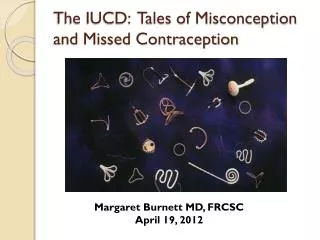
IUCD are small flexible devices made of plastic or metal or in combination meant for insertion into uterus cavity for contraception. • Grafenberg ring • 1960 Lippes loop • Frames are made of polyethylene, (P-Ethylene vinyl acetate) • Impregnated with barium sulphate – radio opaque • All IUCD have nylon tail
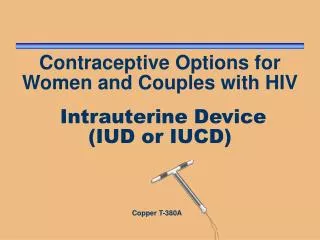
TYPES : Three generations • First generation : Lippe’s loop • Second generation : Contain copper • CuT 200, multiload 250 • CuT 380A, CuT 220c, Nova T, multiload 375 • Third generation : Hormone containing – P LNG • Open / closed • Copper IUCD are of several types N • No against the designation of each device denotes the surface area of copper in mm2 • Copper T 220c and CuT 380A are available in NFPP • CuT 200 are effective for five year • CuT 380A – 10 years
Hormone releasing IUCD • Acts as a delivery system for the hormones. • Beneficial to women with menorrhagia. Progestasart : • T shaped device made of ethylene vinyl acetate copolymer • Vertical shaft is fitted with a capsule contain 38mg of progesterone. • 65mg/day • To be replaced every year.
Levonorgestrel devices : • LNG 20 mirena, Levonova emiley • Delivers 20mg of LNA/day • Replaced every 5 years • MOA : Blocks sperm migration. • Spermicidal effect of lysocomal activation • Accelerated lirbal motility. • makes end hostile to implantation.
Advantages : • Effective soon after insertion • Not linked to sexual activity • Not interferes with intercourse • No need for constant motivation • No risk of drug interaction • Does not affect breast feeding • Removal of device is easy • Return of fertility is noted soon after removal • No systemic side effects
Disadvantages : • Do not protect from STD
Complications : • Cramps syncopal attacks • Perforation • Expulsion • Menorrhagia • Infection
Indications : • Parous women in R. age breast feeding mothers as postcoital contraception C/I : • Suspected pregnancy • Abnormalities GT • PID • Cervicilin/vaginities • Genital bleeding • Uterine pathology • Severe anemia • Previous h/o EP • Multiple sexual partners
Time of insertion • Post menstrual • Postnatal – 6 weeks • Post placental • After an abortion 1 trimester • MTP
Technique of insertion • Post insertion advice • Missing CuT threads
IUCD – an effective reversible long term c. method. Each device has a Nylon thread attached to lower end. • They have a life of 3-5 years. 50g of cu is eluted daily in the uterus. • Copper T 380A – paraguard – 10 years • Progestasart is T shaped has 38mg of progesterone. 65mg of hormone is released daily. • Forms thick plug of mucus – prevents sperm penetration • Required yearly replacement.
Mirena : • contained 52mg of LNG – releasing 20mg daily. • Life of 5 years FR of 0.1 – 0.4 HWY • Frameless IUCD and fibroblast releasing 14mcg P daily for 3 years. • Gyneflex is 3-4cu long, 12mm in width adapts to the shape of uterine cavity. • It contained 6 copper beads on monofilament poly propylene thread. Thread is knotted at one end which is fixed to the fundus. • Ensure device within the intramural portion of FT
Patient selection : • Low risk for STD • Multiparous • Monogamous relationship • Desirous of long term reversible method, but not permanent method. • Unhappy / unreliable user of ocp.
Uses : • Contraception • Post coital contraception • Following excision of uterine septum. Asherman’s syn. • Hormonal in menorrhagia. • In women on tamoxifen for breast ca. Mirena can counteract Endo hyperplasia.
C/I : • Suspected pregnancy • PID • Presence of fibroids • Severe anemia • Diabetic • Heart disease • Previous ectopic • Scarred uterus • Avoid in unmarried / nullipara • Septate uterus
During / soon after period • After MTP • Immediate PP • 24 hr. of delivery • 6 weeks PN
MOA : • Foreign body in uterus renders irrigation of spermatozoa difficult. • FB provokes uterine contractility thro’ PG’s, decreased tubal peristalsis. • Leucotytic infiltration in endo. Macrophages engulf the fertilized egg. • Released copper brings about certain enzymatic and metabolic change in endometrial tissue. • Progesterone carrying devices alters the cervical mucus which prevent sperm penetration, endometrial atrophy.
Complication : • Immediate : • Difficulty in insertion • Vasovagial attack • Uterine cramps
Early : • Expulsion (2-5%) • Perforation (1-2%) • Spotting, menorrhagia • Dysmenorrhea • Vaginal infects • Actinomycosis
Late : • PID • Pregnancy • Ectopic pregnancy • Menorrhagia
Misplaced IUCD : • Causes are – uterus has enlarged thro’ preg. • Threads have curled up • Perforation has occurred • Expelled out