LHC Operational Updates and Stable Beams Achievements for February 9, 2013
On February 9, 2013, the Large Hadron Collider (LHC) at CERN experienced several stable beam fills (3541 to 3544) and performed various operational tests, including Van der Meer scans and intensity ramp-up procedures for proton-proton collisions. Key milestones included successful leveling of ALICE, beam dumps due to BPMS signals, and preparations for an upcoming high-intensity run. Noteworthy statistics recorded for the day involved multiple collisions and essential checks to ensure beam stability and integrity.


LHC Operational Updates and Stable Beams Achievements for February 9, 2013
E N D
Presentation Transcript
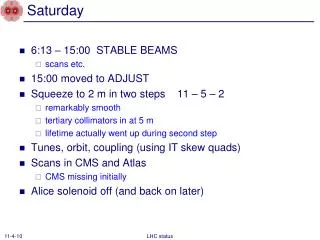
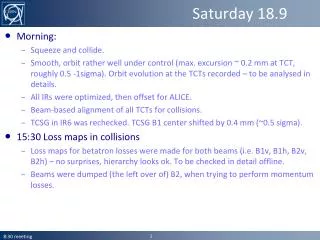
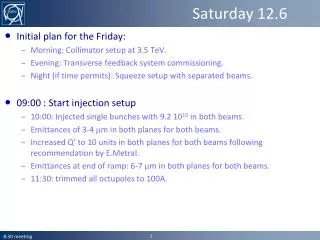
Saturday 9.2.2013 • 02:42 stable beams fill 3541 • 7:45 beam dump by BPMS IP6 after 5 h in stable beams • 8:35 re-injecting for LHCbVdM scan 338/338 bunches/beam • 10:40 stable beams fill 3542 • 11:13 ALICE leveling reached head-on: start Van der Meer scan and length scale calibration in LHCb • 13:30 VdM scan completed, re-optimize all collisions • 15:00-15:19 Adjust: • Test for 50Hz noise / instability studies by separating the beams and reducing / switching off the ADT gain • 15:19 operator beam dump • 16:09 re-injecting • 18:31 stable beams fill 3543
Night • 19:39 ALICE leveling in head-on • 1:06 beam dump by BPMS IP6 after 6.5 h in stable beams • 1:54 re-injecting – very good beam from injectors • 3:28 stable beams fill 3544 B1H B1V
Morning • 6:04 OP dump of the last Pb-p fill after 2.5 h in stable beams • ATLAS records ALICE: 31.14 nb-1 ATLAS: 30.25 nb-1 CMS: 30.79 nb-1 LHCb: 2.08 nb-1
Preparations for pp run • Access starts at 7:00 • Already done:- hypercycle change- RF ramp rate back to 40Hz/s- ADT injection gain to 0.08 (to be checked/confirmed)- launched ALICE solenoid/dipole sequences for polarity change- launched RU.L4 reset sequence
1.38 TeV p-p run • Access to set-up for the higher intensity start at 7:00 AM • BPMS IP6 (high intensity protons), BBQ, Head-Tail, etc • ADT settings for high intensity (HW SR4) and possibly attenuator change (piquet) • Re-activate RF hardware interlock on total voltage (can be done before during ramp down) • Reverting ALICE polarity (LHCb polarity already good) • Revert BLM MFs • Revert BTVDD delay settings • Revert BPMS interlock windows to 70/100 • ATLAS, CMS • Pre-cycle ~ 1 hour • 1 cycle with probes for checkout, correcting chroma and tune, verify instrumentation and damper set-up 10:00 – 14:00 • Testing of interlock BPMS (~2 hours) • Loss maps at injection and asynchronous dump (4 hours)
1.38 TeV p-p run • 1 cycle with 5 bunches 8-9x10^10 p/bunch for collimator setup (TCTs), collision setup, first loss maps & asynch. dump test in collision. (4-5 hours+ RP set-up and 1 hour data taking - if approved) • BSRT (B2) and beam dump checks with high intensity and LBDS check (B1) in parallel (5 hours) • 1 cycle to complete off-momentum/betatron loss maps (4 hours). • The hypercycle for 1.38 TeV is : 1.38TeV_2013. • Set total RF voltage to 10 MV at flat top for both beams. B1 is at 12 MV now.
1.38 TeV p-p run • Intensity ramp-up • 1 fill with ~80 bunches • 1 fill with ~500 bunches (including some individual bunches for VdM scans) • 1374 bunches • Need to define filling scheme for 500 bunches
Validation tbd=to be done
Pending • Accesses for quench test: • Scope installation in IP6 (12L6). 2 hours. Ithaspriority over Q6L8 scope installationbecausewewillneedit on Mondaymorning (the first quench test). To be confirmedwhetherit can be donebefore high intensitytests/ppphysicsat intermediate energy • Fast measurement system on RQ6.L8 (30 min in the UA83 by Jaromir Ludwig). Ramp to 300 A afterwards. • LBDS check (E. Carlier – working hours) if in the shadow of anotheraccess