Understanding Lunar Phases: Apogee, Perigee, and the Moon's Cycle
Explore the fascinating world of lunar phases, including the definitions of apogee, perigee, crescent, and gibbous phases. Discover how these terms relate to the moon's distance from Earth and its visibility. Learn about the moon's orbital period, including the 27.5-day sidereal month and the 29.5-day synodic month, which describes the cycle of lunar phases. This educational overview provides insights into why we always see the same side of the moon and the waxing and waning phases.

Understanding Lunar Phases: Apogee, Perigee, and the Moon's Cycle
E N D
Presentation Transcript
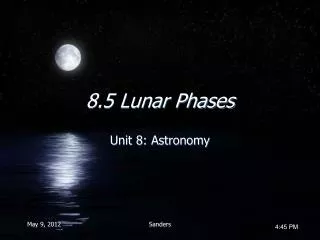
8.5 Lunar Phases Unit 8: Astronomy Sanders
Vocabulary • apogee: point at which the moon is farthest from the earth Unit 8: Astronomy
Vocabulary • apogee: point at which the moon is farthest from the earth • crescent: phase when less than half the moon is visible Unit 8: Astronomy
Vocabulary • apogee: point at which the moon is farthest from the earth • crescent: phase when less than half the moon is visible • gibbous: phase when more than half the moon is visible Unit 8: Astronomy
Vocabulary • apogee: point at which the moon is farthest from the earth • crescent: phase when less than half the moon is visible • gibbous: phase when more than half the moon is visible • perigee: point at which the moon is closest to the earth Unit 8: Astronomy
Vocabulary • apogee: point at which the moon is farthest from the earth • crescent: phase when less than half the moon is visible • gibbous: phase when more than half the moon is visible • perigee: point at which the moon is closest to the earth • phases: changing shapes of the moon Unit 8: Astronomy
Months • It takes the moon 27.5 days to rotate once on its axis. Unit 8: Astronomy
Months • It takes the moon 27.5 days to rotate once on its axis. • This is called a sidereal month. Unit 8: Astronomy
Months • It takes the moon 27.5 days to rotate once on its axis. • This is called a sidereal month. • It is the time cycle that it takes moon to make one full orbit Unit 8: Astronomy
Months • A complete cycle of the moon's phases takes 29.5 days. Unit 8: Astronomy
Months • A complete cycle of the moon's phases takes 29.5 days. • This is called a synodic month. Unit 8: Astronomy
Sidereal - Synodic? • This 2.5 day difference occurs because as the moon orbits Earth, Earth orbits the sun. Unit 8: Astronomy
Sidereal - Synodic? • This 2.5 day difference occurs because as the moon orbits Earth, Earth orbits the sun. • When the moon gets back to its original position, it must move the extra distance to make up for the Earth’s travels in its orbit. Unit 8: Astronomy
Why do we see the same side of the moon? • To sum up; the periods of rotation and revolution for the moon are equal. Unit 8: Astronomy
Why do we see the same side of the moon? • To sum up; the periods of rotation and revolution for the moon are equal. • Turn to page 15 of the ESRT. Unit 8: Astronomy
Why do we see the same side of the moon? • To sum up; the periods of rotation and revolution for the moon are equal. • Turn to page 15 of the ESRT. Unit 8: Astronomy
Phases • Note that the waxing moon has light on the right side of the moon. • The waning side has light on the left. Unit 8: Astronomy