Properties of Logarithms Section 4.3
150 likes | 281 Vues
This resource outlines the fundamental properties of logarithms, including the Product Rule, Quotient Rule, and Power Rule. Each rule is clearly explained with examples to illustrate their application. Discover how to simplify, expand, and condense logarithmic expressions effectively using these properties. The text addresses logarithms in different bases and highlights the importance of using the Change of Base formula. Perfect for students looking to grasp the essential concepts of logarithms for calculus and algebra.


Properties of Logarithms Section 4.3
E N D
Presentation Transcript
Properties of LogarithmsSection 4.3 JMerrill, 2005 Revised, 2008
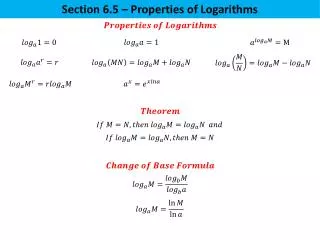
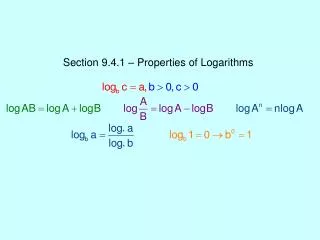
Rules of LogarithmsIf M and N are positive real numbers and b is ≠ 1: • The Product Rule: • logbMN = logbM + logbN (The logarithm of a product is the sum of the logarithms) • Example: log4(7 • 9) = log47 + log49 • Example: log (10x) = log10 + log x
Rules of LogarithmsIf M and N are positive real numbers and b ≠ 1: • The Product Rule: • logbMN = logbM + logbN (The logarithm of a product is the sum of the logarithms) • Example: log4(7 • 9) = log47 + log49 • Example: log (10x) = log10 + log x • You do: log8(13 • 9) = • You do: log7(1000x) = log813 + log89 log71000 + log7x
Rules of LogarithmsIf M and N are positive real numbers and b ≠ 1: • The Quotient Rule (The logarithm of a quotient is the difference of the logs) • Example:
Rules of LogarithmsIf M and N are positive real numbers and b ≠ 1: • The Quotient Rule (The logarithm of a quotient is the difference of the logs) • Example: • You do:
Rules of LogarithmsIf M and N are positive real numbers, b ≠ 1, and p is any real number: • The Power Rule: • logbMp = p logbM (The log of a number with an exponent is the product of the exponent and the log of that number) • Example: log x2 = 2 log x • Example: ln 74 = 4 ln 7 • You do: log359 = • Challenge: 9log35
Prerequisite to Solving Equations with Logarithms • Simplifying • Expanding • Condensing
Simplifying (using Properties) • log94 + log96 = log9(4 • 6) = log924 • log 146 = 6log 14 • You try: log1636 - log1612 = • You try: log316 + log24 = • You try: log 45 - 2 log 3 = log163 Impossible! log 5
Using Properties to Expand Logarithmic Expressions • Expand: Use exponential notation Use the product rule Use the power rule
Condensing • Condense: Product Rule Power Rule Quotient Rule
Condensing • Condense:
Bases • Everything we do is in Base 10. • We count by 10’s then start over. We change our numbering every 10 units. • In the past, other bases were used. • In base 5, for example, we count by 5’s and change our numbering every 5 units. • We don’t really use other bases anymore, but since logs are often written in other bases, we must change to base 10 in order to use our calculators.
Change of Base • Examine the following problems: • log464 = x • we know that x = 3 because 43 = 64, and the base of this logarithm is 4 • log 100 = x • If no base is written, it is assumed to be base 10 • We know that x = 2 because 102 = 100 • But because calculators are written in base 10, we must change the base to base 10 in order to use them.
Change of Base Formula • Example log58 = • This is also how you graph in another base. Enter y1=log(8)/log(5). Remember, you don’t have to enter the base when you’re in base 10!