CS 341 Programming Language Design and Implementation
This document covers key exercises and discussions from CS.341, focusing on implementing sorting algorithms using F#. It provides step-by-step instructions on writing selection sort and quicksort, including code examples and environment setup with Visual Studio and online IDEs. Included are insights on performance timing for sorting large lists (1,000 to 1,000,000 elements), analysis of runtime complexities, and considerations for effective recursion versus excessive list building. Useful for students mastering algorithm design and implementation.

CS 341 Programming Language Design and Implementation
E N D
Presentation Transcript
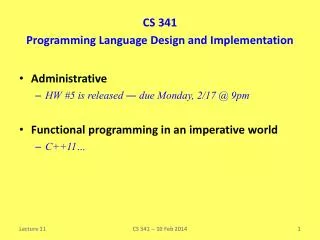
CS 341 Programming Language Design and Implementation • Administrative • HW #5 is out ― due Monday, 2/17 @ 9pm • Quiz #2? Also next Monday, 2/17 • Switching back to F#... • Programming day! • Let's start with sorting… CS 341 -- 12 Feb 2014
Startup an F# environment, either will work: • http://ideone.com • Visual Studio • Copy-paste timing code: • "Sorting.fs" • http://www.joehummel.net/uploads/cs341-sorting.fs • Take a minute to run & review code… • start with Main • creates 2 lists, sorts using built-in List.sort function CS 341 -- 12 Feb 2014
Exercise 1 • Selection sort: • Algorithm: find min, move to front, sort the rest… • note that min(L) and remove(e, L) are defined for you • use ordinary (not tail) recursion, 4-5 lines of code… // // selection sort: // let rec selectionsort(L)= . . let Main argv = . . printfn "" runit("selection sort", selectionsort, list1) runit("selection sort", selectionsort, list2) CS 341 -- 12 Feb 2014
Exercise 2 Hint: to split lists, use List.filter — like map, but keeps only those elements where function returns true. 7-8 lines of code… • Quicksort… • select first element as pivot • split remainder into two lists L1, L2: elements <= pivot, elements > pivot • sort L1 and L2 recursively • put pieces back together into a single list // // quicksort: // let rec quicksort(L)= . . let Main argv = . . printfn "" runit("quick sort", quicksort, list1) runit("quick sort", quicksort, list2) CS 341 -- 12 Feb 2014
Timing… • Start to increase the size of the generated list… • 1,000 elements • 10,000 elements • 100,000 elements • 1,000,000 elements comment out call to selectionsort at this point :-) CS 341 -- 12 Feb 2014
Why is quicksort so much slower? • It's not the recursive calls • the recursion is not that deep • It's the excessive list building • the @ operator is building new lists every time… • Solution? • merge sort using :: operator as much as possible… . . quicksort(left) @ [pivot] @ quicksort(right) element :: list // doesn't require constructing a new list: CS 341 -- 12 Feb 2014
Tail recursion? • There was an earlier question about tail recursion: • Automatically, no… • "single-call" recursion (e.g. min) can be rewritten — using helper function and extra "accumulator" parameter • "multi-call" recursion (e.g. quicksort) is not easily rewritten • and rewrite requires use of a stack, so there's no benefit to the TR "Can all recursive functions be rewritten as tail-recursive?" CS 341 -- 12 Feb 2014
Exercise 3 // // standard deviation of L = list of numbers: // // Hint 1: think higher-order // Hint 2: System.Math.Sqrt(…) // let stddev(L)= . . • Standard deviation: CS 341 -- 12 Feb 2014