Download
1 / 36
360 likes | 497 Vues
This study investigates the role of Calcineurin in muscle plasticity, particularly focusing on its influence on fiber type expression in response to different stimuli. Utilizing electrophysiology to measure resting and action potentials, alongside ion channel activity, we examine how Calcineurin regulates mRNA levels of myoglobin, slow TnI, and sarcomeric mitochondrial creatine kinase in gastrocnemius muscle. Additionally, we analyze the effects of muscle overload on fiber type transformation and hypertrophy, highlighting the importance of NFAT signaling in B-lymphocytes and muscle adaptation.

E N D
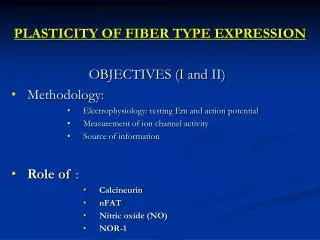
PLASTICITY OF FIBER TYPE EXPRESSION OBJECTIVES (I and II) Methodology: • Electrophysiology: resting Em and action potential • Measurement of ion channel activity • Source of information Role of : • Calcineurin • nFAT • Nitric oxide (NO) • NOR-1
CaM- Binding domain Auto- Inhibitory Domain CATALYTIC DOMAIN CALCINEURIN Calcineurin A (CNA)
CALCINEURIN INCREASES mRNA LEVELS FOR MYOGLOBIN, SLOW TnI AND SARCOMERIC MITOCHONDRIAL CREATINE KINASE IN GASTROCNEMIUS MUSCLE
CALCINEURIN DECREASES mRNA LEVELS FOR PARVALBUMIN AND MUSCLE CREATINE KINASE IN GASTROCNEMIUS MUSCLE
ACTIVATION OF NF-ЌB, JNK1 AND NFAT IN Ca2+ spike vs. prolonged elevation
ACTIVATION OF NF-ЌB, JNK1 AND NFAT IN small prolonged elevation of Ca2+
ACTIVATION OF NF-ЌB, JNK1 AND NFAT IN Ca2+ dose-response curve
MUSCLE OVERLAOD CAUSES A CALCINEURIN DEPENDENT INCREASE IN TYPE I FIBERS
MUSCLE OVERLAOD CAUSES A CALCINEURIN DEPENDENT CHANGE IN mRNA OF MHC AND TnI