A Probabilistic Model for Component-Based Shape Synthesis
This paper presents a generative model that synthesizes plausible 3D shapes automatically by understanding and representing shape variability across structural, geometric, and stylistic dimensions. The model is learned without supervision from a set of segmented shapes and captures the latent causes of the observed variability in shape. We demonstrate its ability to combine components from various categories to create new shapes, thereby advancing the state of shape synthesis in computer graphics.
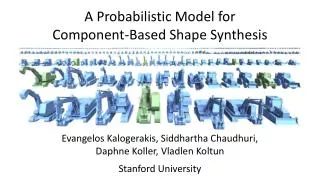

A Probabilistic Model for Component-Based Shape Synthesis
E N D
Presentation Transcript
A Probabilistic Model for Component-Based Shape Synthesis EvangelosKalogerakis, Siddhartha Chaudhuri, Daphne Koller, VladlenKoltun Stanford University
Challenge: understand shape variability • Structural variability • Geometric variability • Stylistic variability Our chair dataset
Related work: variability in human body and face • A morphable model for the synthesis of 3D faces [Blanz & Vetter 99] • The space of human body shapes [Allen et al. 03] • Shape completion and animation of people [Anguelov et al. 05] [Allen et al. 03] Scanned bodies
Related work: probabilistic reasoning for assembly-based modeling [Chaudhuri et al. 2011] Inference Modeling interface Probabilistic model
Related work: probabilistic reasoning for assembly-based modeling
Our probabilistic model • Synthesizes plausibleand complete shapesautomatically
Our probabilistic model • Synthesizes plausibleand complete shapesautomatically • Represents shape variability at hierarchical levels of abstraction
Our probabilistic model • Synthesizes plausibleand complete shapesautomatically • Represents shape variability at hierarchical levels of abstraction • Understands latent causes of structural and geometric variability
Our probabilistic model • Synthesizes plausibleand complete shapesautomatically • Represents shape variability at hierarchical levels of abstraction • Understands latent causes of structural and geometric variability • Learned without supervision from a set of segmented shapes
Learning shape variability We model attributes related to shape structure: Shape type Component types Number of components Component geometry P( R, S, N, G)
R P(R)
R P(R)
R Nl L Π P(R)[P(Nl|R)] l ∈L
R Nl Sl L Π P(R)[P(Nl|R) P (Sl|R )] l ∈L
R Nl Sl L Π P(R)[P(Nl|R) P (Sl|R )] l ∈L
R Nl Sl Dl Cl L Π P(R)[P(Nl|R) P (Sl|R ) P(Dl|Sl ) P(Cl| Sl )] l ∈L
R Nl Sl Width Dl Cl L Height Π P(R)[P(Nl|R) P (Sl|R ) P(Dl|Sl ) P(Cl| Sl)] l ∈L
R Latent object style Nl Sl Latent component style Dl Cl L Π P(R)[P(Nl|R) P (Sl|R ) P(Dl|Sl ) P(Cl| Sl )] l ∈L
R Nl Sl Learn from training data: latent styles lateral edges parameters of CPDs Dl Cl L
Learning Given observed data O, find structure G that maximizes:
Learning Given observed data O, find structure G that maximizes:
Learning Given observed data O, find structure G that maximizes:
Learning Given observed data O, find structure G that maximizes:
Learning Given observed data O, find structure G that maximizes: Assuming uniform prior over structures, maximize marginal likelihood:
Learning Given observed data O, find structure G that maximizes: Assuming uniform prior over structures, maximize marginal likelihood: Complete likelihood
Learning Given observed data O, find structure G that maximizes: Assuming uniform prior over structures, maximize marginal likelihood: Parameter priors
Learning Given observed data O, find structure G that maximizes: Assuming uniform prior over structures, maximize marginal likelihood:
Learning Given observed data O, find structure G that maximizes: Assuming uniform prior over structures, maximize marginal likelihood: Cheeseman-Stutz approximation
Shape Synthesis Enumerate high-probability instantiations of the model {} {R=1} {R=2} {R=1,S1=1} {R=1,S1=2} {R=2,S1=2} {R=2,S1=2} …
Component placement Unoptimizednew shape Optimizednew shape Sourceshapes
User Survey Synthesized shapes Training shapes
Results Source shapes (colored parts are selected for the new shape) New shape
Results Source shapes (colored parts are selected for the new shape) New shape