Download
1 / 6
60 likes | 178 Vues
This document provides an update on the status of the New Congestion Window Variation (CWV) internet draft as of July 2014, reflecting several revisions made after community review. Key changes include clarified terminology regarding data-limited concepts, specification of in-scope and out-of-scope elements, and a more conservative reduction of the congestion window after losses compared to standard TCP. It details new implementation patches for the Linux kernel and FreeBSD, along with a summary of experimental results with data-limited flows. Feedback and comments on the draft are encouraged.

E N D
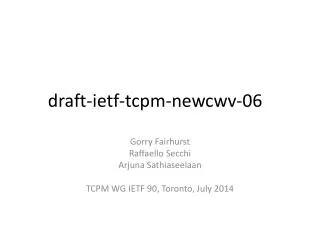
draft-ietf-tcpm-newcwv-06 GorryFairhurst RaffaelloSecchi ArjunaSathiaseelaan TCPM WG IETF 90, Toronto, July 2014
Status of Internet draft • Several changes to the draft -06 after review: • Terminology clarified (data-limited concept) • Specified what is in-scope and out-of-scope • new-CWV is more conservative than standard TCP in reducing cwnd after loss • Clarified differences between PipeACK and FlightSize • No changes to the method • WG Chairs changed intended status to “Experimental “ pending experience with deployed implementations
Status of NewCWV implementation • New Linux kernel patch (R Secchi) • Linux kernel 3.14 • Interoperable with other CC schemes • Fixes cases when congestion is local • Patch for Free BSD under review (T Jones) • Patch freedbsd-net (30/6/2014) • Bug 191520
Example experiments withdata-limited flow: 427 kb/s VBR Flow The flow is NOT paced TCP Reno TCP Cubic Path characteristics: Bottleneck capacity = 1 Mb/s Bottleneck buffer latency = 200ms (18 MSSs) Round-trip propagation delay = 100ms
Example experiments with data-limited flow: • 427 kb/s VBR Flow The flow is paced: Linux FQ scheduler TCP Reno TCP Cubic Path characteristics: Bottleneck capacity = 1 Mb/s Bottleneck buffer latency = 200ms (18 MSSs) Round-trip propagation delay = 100ms
Current Plans • Using new-cwv in our labs • Feedback on implementations welcome • Comments on draft welcome