Advancements in Adaptive Traffic Management: Flexible Appointment-Based Systems
This presentation discusses innovative operational decision-making systems used in trade and transportation to improve efficiency and reduce delays. It explores appointment-based scheduling strategies to manage freight traffic effectively, highlighting projects like PREDICT (FDA), Global Trader (DoD), and systems in Jordan and Pakistan. Dr. Amrinder Arora presents approaches to tackle traffic-related challenges, adjusting appointments dynamically and utilizing predictive modeling to optimize vehicle processing times. Discover how these solutions enhance coordination and performance in freight logistics.

Advancements in Adaptive Traffic Management: Flexible Appointment-Based Systems
E N D
Presentation Transcript
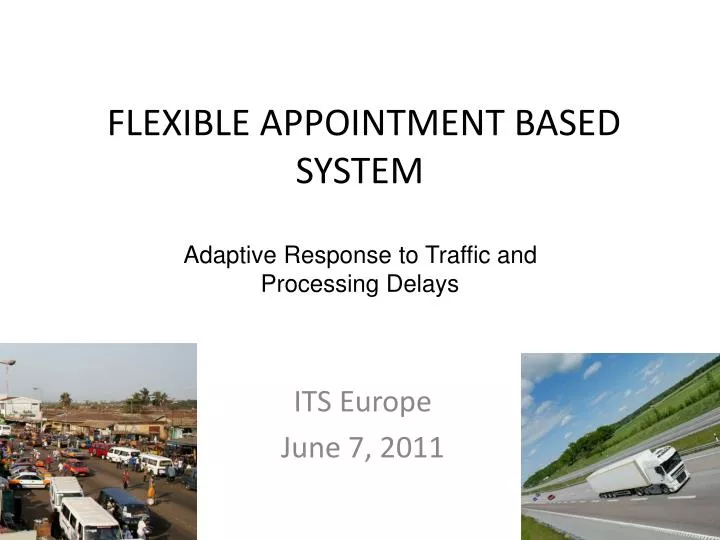
FLEXIBLE APPOINTMENT BASED SYSTEM Adaptive Response to Traffic and Processing Delays ITS Europe June 7, 2011
Introduction Delivers advanced operational decision-making systems in trade and transportation, and other verticals Example Programs: • PREDICT – U.S. Food & Drug Administration • Global Trader – U.S. DoD • Aqaba Truck Control System (Jordan) • Karachi Port Access Workflow System (Pakistan) Dr. Amrinder Arora Vice President – Technology Solution Lead, Nafith TCS Solution Lead, FDA – PREDICT Adjunct Faculty, Department of Computer Science, GWU
Understanding Transportation Delays.. • Processing Delays/Delays due to visibility • Delays due to congestion • Delays due to security
Eliminating Delays …one component at a time
Our Focus (this presentation) • Scheduling/Appointment Based • Risks with Appointment Based Systems • Underutilization if too conservative • Handle no shows • Ensure appointments cannot be “sold”
Our Approach • Develop models for predicting arrival times • Be adaptive – Adjust appointments if necessary • MultiCurveGA – Develop models • AdjustAppointments
Predictive Modeling for Arrivals • Vessel data • Terminal processing times and delays • Real-time traffic delays and vehicle speeds on access roads • Location from participating trucks • Road closures and detours
Application 1 – Syria-Jordan FTZ Syria Jordan
Syria-Jordan FTZ – Before FTZCS The Process Trucks unload/load and leave FTZ. Indeter-minate waits Trucks queue at FTZ and nearby villages. No check on capacity; trucks enter FTZ. Operations slow as trucks congest FTZ. • Sense of disorder and chaos concerns FTZ and Customs officials • Long, indeterminate trip times due to truck/load/docs problems • Poor coordination between trucks and businesses within FTZ • Frequent altercations between truck drivers and villagers • FTZ unable to keep up with demand • No performance measurements The Problems
The New Process Dispatcher requests appointment with specific FTZ business TCS checks capacity at gate and business. Confirms request. Trucks dispatched for appointments enter FTZ without delay Monitor and report truck, system and people performance • FTZ and Customs have greater comfort with orderliness of FTZ operations • Less variable processing times for trucks • Village councils have confirmed reduction in incidents between truck drivers and villagers • Greater volumes handled by FTZ • Total time requirement for truck operation at FTZ reduced Results
Application 2 – Karachi Port Access Workflow System (Pakistan)
Seaports, logistics centers, dry ports and industrial areas are all candidates for better freight traffic management • Need to place as much focus outside the terminal gates for efficiency, as inside • Evaluate all options – capacity based, appointment based, variable tariff based – they are not mutually exclusive
Dr. Amrinder Arora aarora@ntelx.com amrinder@gwu.edu