Building and using pluggable type systems
Discover the advantages of pluggable type systems in Java programming through Michael D. Ernst's work at the University of Washington and Mahmood Ali at MIT. This framework improves type checking to reduce bugs related to null dereferences, mutation, concurrency, and security. Learn how to design and implement your own custom type checkers using the Checker Framework, which integrates with tools like javac and Eclipse. With features such as generics support, local type inference, and minimal false positives, the framework has demonstrated effectiveness in large codebases.

Building and using pluggable type systems
E N D
Presentation Transcript
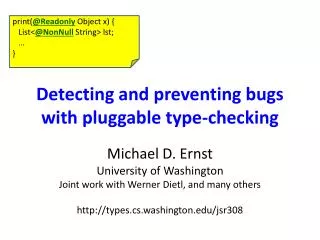
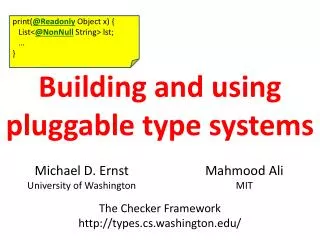
print(@Readonly Object x) { List<@NonNull String> lst; … } • Building and using • pluggable type systems Michael D. Ernst University of Washington Mahmood Ali MIT The Checker Framework http://types.cs.washington.edu/
Type checking has been wildly successful, but… Type checking prevents too few bugs The annotation you write: The property you care about: • Null dereferences @NonNull • Mutation and side-effects @Immutable • Concurrency: locking @GuardedBy • Security: encryption, @Encryptedtainting @Untainted • Aliasing @Linear • Equality tests @Interned • Strings: localization, @Localizedregular expression syntax, @Regexsignature format@FullyQualified • Typestate (e.g., open/closed files)@State • You can write your own checker!
Solution: Pluggable type systems • Design a custom type system • Write type qualifiers in code @Immutable Date date = new Date(0); date.setTime(70); • Type checker warnsabout violations (bugs) compile-time error % javac -processor NullnessChecker MyFile.java MyFile.java:149: dereference of possibly-null reference bb2 allVars = bb2.vars; ^
Features • Full type system • Inheritance • Overriding • Generics (type and qualifier polymorphism) • Local type inference • Qualifier defaults • Warning suppression • Tool integration: javac, Eclipse, Ant, Maven • Global inference tools: nullness, mutability
Results: Effective and easy to use • Effective: found >300 bugs, in the JDK, Google Collections, Lucene, Xerces, ASM, SVNKit, … • Few false positives • Easy to use • Used by students in the first CS majors class at UW • My group has annotated 3 million lines of code • Annotations are not verbose • Fewer than 1 per 75 lines
Writing a new checker: Taint checker The complete code To use it: • Write @Untainted in your program List getPosts(@Untainted String category) {…} • Compile your program javac -processor BasicChecker -Aquals=Untainted MyProgram.java @TypeQualifier @SubtypeOf(Unqualified.class) @ImplicitFor(trees = {STRING_LITERAL}) public @interface Untainted { } Simple type-checkers are very easy to write; complicated ones are possible to write
Pluggable type-checking • Java 8 syntax for type annotations • Write in comments during transition to Java 8 • Checker Framework for creating type checkers • Featureful, effective, easy to use, scalable • Prevent bugs at compile time • Create custom type-checkers • Learn more, or download the Checker Framework: http://types.cs.washington.edu/jsr308 (or, web search for “Checker Framework” or “JSR 308”)