Download
1 / 25
250 likes | 356 Vues
This presentation, aimed at pre-service teachers from West Chester University, provides insights into understanding and supporting students with exceptionalities, particularly in music education. Led by Elena Tobin, MS, and Kathy Wilkins, Ph.D., the session covers various disorders, including Autism Spectrum Disorders and learning disabilities. Participants engage in activities like KWL charts to discuss effective teaching strategies and modifications. The workshop emphasizes the importance of accommodating diverse learners and integrating writing and communication skills within the music curriculum.

E N D
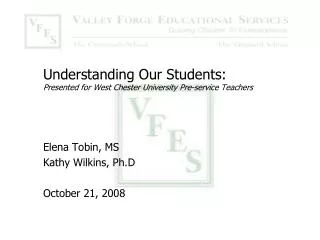
Understanding Our Students:Presented for West Chester University Pre-service Teachers Elena Tobin, MS Kathy Wilkins, Ph.D October 21, 2008
Our Afternoon - Agenda • Introduction - KWL “Icebreaker” • Disorders Defined • Music Class Observation • In the Eyes of Our students • Classroom Application
KWL – Icebreaker • Generate together ideas to add to our “KWL Chart” • Discuss and report out together
The Exceptionalities Served at Vanguard • Autism Spectrum Disorders • Autism • Asperger’s • Pervasive Developmental Disorder NOS • Neurological Impairment (OHI) • Emotionally Disturbed
Disorders under ASD • Autism • Aspergers Disorder • Pervasive Developmental (NOS)
STOP & Think! Based on the opening KWL activity and Autism/Asperger’s information, talk about something new you learned.
Other Health Impaired (OHI) • Broad spectrum of neurological disorders or impairments represented – mild to moderate CP, active seizure disorder, brain injury from illness, inoculations, or surgical difficulty, mild TBI. • Neurological impairments create a broad spectrum of learning disabilities
Emotionally Disturbed • For the students this classification refers to more “internalizing emotional disorders” such as depression, anxiety, mood disorders – not disruptive behavior disorder or conduct disorder • These students tend to be higher functioning cognitively and academically • The focal teaching strategies and instructional modifications used for ASD students work well for ED students
Types of Learning Differences • Communications and Speech/language disorders –These students have difficulty with the pragmatics of speech • Reading disorders – decoding may be good but unable to comprehend or make inferences • Math disorders – significant difficulty with word problems • Writing Disorders – inability to transform thought to written word
Neurosocial Disorders Inability to read non-verbal communications such as facial expressions, tone of voice, body language Seen traditionally in students diagnosed with Non-verbal Learning Disorder and Asperger’s Inability to self-monitor or recognize how one’s behavior affects the behavior of others Lack of empathy or understanding of what others may experience – mind-blindness
Typical Supports in a School District • Speech/Language Therapy • Occupational Therapy – fine motor and sensory processing • School Counseling and School Psychologists • Reading Specialists • Behavior Support/TSS Let’s view a simulation…
STOP & Think! Reflect: What were your thoughts about the anxiety simulation of the learning disabled child?
Let’s Talk About Writing… • Writing Development 101 • Writing through the eyes of a child with learning disabilities • Strategies for your classroom
What is Writing?Most teachers expect students to: • Express thoughts on paper: • Must have Ideas • Organize • And Sequence with • Proper Conventions …to develop a coherent and logical sample All at the same time!
Curriculum Demands Requiring Writing Skills • Formats • Essays • Paragraph writing • Book reports • Journals • Tests, quizzes • Worksheets • Note Taking • Homework • Research
STOP & Think! How often could your students be reading and writing during Music class? What do you envison?
What Skills Should Students Have? • It is a gradual process that occurs over time and builds on previous learning. • Writing requires: • Planning and organization • Retrieval of words and sentences • Spelling, sentence construction, transitions, pace, and flow of ideas • Ability to perceive reader’s needs and interests
What Do We Know? Our students have difficulty due to common factors: • Cognitive and language development • Auditory processing issues • Physical/fine motor control • Frustration, “I hate writing, I can’t do this” • Overall reluctance due to one or more of above factors What this may look like:
Writing is a Mechanical Process • Graphomotor • Holding the tool • Moving the tool – motor patterns • Perceptual skills • Left to right • Top to bottom • Spacing • Visual What this may feel like:
STOP & Think! How can you accommodate students with disabilities in your classroom?
Modified Music Activity • “Let’s talk about the composer Handel.” • Independent work OR in pairs • Sample 1 & Sample 2 • Adapt sheet music?
Differentiating Music Instruction • Gardener’s seven intelligences • Multiple modalities • Visual and auditory input
Slide taken from: http://www.authorstream.com/presentation/tccampa-65510-gardner-multiple-intelligences-intelligence-psychology-intell-type-education-ppt-powerpoint/
Differentiating Music Instruction • DI in a box • What’s around your school? • Model classroom environment: Make a word wall, centers, utilize technology
Additional Tips • Knowledge is Power: Ask reading specialists for student reading levels to assist with your activities. • Add reading level information to your substitute folder, and adapted work as necessary • Students with IEPs: ask special education teacher for a copy of “SDI” section (Specially Designed Instruction) with list of accommodations - keep as a reference • Resources to take with you: • All Presentation materials: http://edtechdiva.wikispaces.com • Green packet – 10 tips for school staff