Understanding Enthalpy of Solution in Higher Grade Chemistry: Calculation Methods Explained
30 likes | 159 Vues
This resource dives into the concept of enthalpy of solution, illustrating the energy change when a substance dissolves in water. A worked example using 5g of ammonium chloride demonstrates the calculations involved, revealing an endothermic process as the solution's temperature decreases. Additional exercises include calculating the enthalpy change for ammonium nitrate and an unknown compound, including temperature change scenarios. Ideal for higher grade chemistry students seeking to master thermodynamic calculations in aqueous solutions.


Understanding Enthalpy of Solution in Higher Grade Chemistry: Calculation Methods Explained
E N D
Presentation Transcript
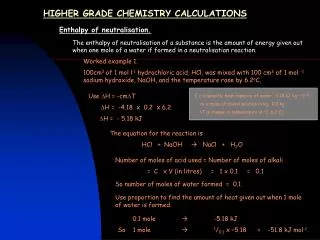
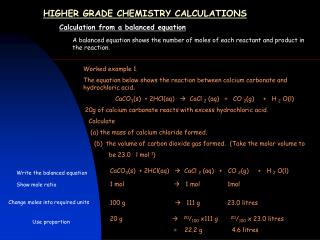
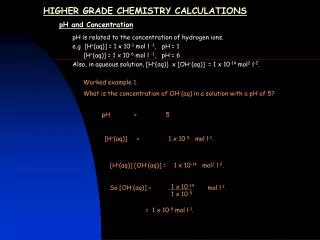
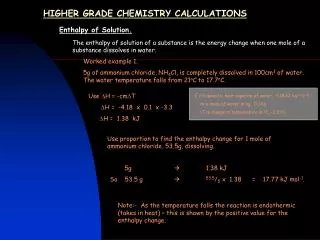
Use DH = -cmDT DH = -4.18 x 0.1 x -3.3 DH = 1.38 kJ ( c is specific heat capacity of water, 4.18 kJ kg-1oC-1) m is mass of water in kg, 0.1 kg DT is change in temperature in oC, -3.3oC) HIGHER GRADE CHEMISTRY CALCULATIONS The enthalpy of solution of a substance is the energy change when one mole of a substance dissolves in water. Worked example 1. 5g of ammonium chloride, NH4Cl, is completely dissolved in 100cm3 of water. The water temperature falls from 21oC to 17.7oC. Enthalpy of Solution. Use proportion to find the enthalpy change for 1 mole of ammonium chloride, 53.5g, dissolving. 5g 1.38 kJ So 53.5 g 53.5/5 x 1.38 = 17.77 kJ mol-1. Note:- As the temperature falls the reaction is endothermic (takes in heat) – this is shown by the positive value for the enthalpy change.
Calculations for you to try. • 8g of ammonium nitrate, NH4NO3, is dissolved in 200cm3 of water. • The temperature of the water falls from 20oC to 17.1oC. Use DH = -cmDT DH = -4.18 x 0.2 x -2.9 DH = 2.42 kJ Use proportion to find the enthalpy change for 1 mole, 80g, of ammonium nitrate dissolving. 8g 2.42 kJ So 80g 80/8 x 2.42 = 24.2 kJ mol-1. 2. When 0.1 mol of a compound dissolves in 100cm3 of water the temperature of the water rises from 19oC to 22.4oC . Calculate the enthalpy of solution of the compound. Use DH = -cmDT DH = -4.18 x 0.1 x 3.4 DH = -1.42 kJ Use proportion to find the enthalpy change for 1 mole of the compound. 0.1 mol - 1.42 kJ So 1 mol 1/0.1 x -1.42 = -14.2 kJ mol-1. Higher Grade Chemistry
Rearranging DH = -cmDT Gives DT = DH -cm 3.35 -4.18 x 0.15 DT = = -5.34 oC • Calculations for you to try. • The enthalpy of solution of potassium chloride, KCl, is + 16.75kJ mol-1. • What will be the temperature change when 14.9g of potassium chloride • is dissolved in 150cm3 of water? Use proportion to find the enthalpy change for 14.9g of potassium chloride dissolving. 74.6g (1 mol) 16.75 kJ So 14.9g 14.9/74.6 x 16.75 = 3.35 kJ Higher Grade Chemistry