Exploring Catal Hoyuk and Jericho: The Neolithic Revolution and Early Settlements
160 likes | 265 Vues
Dive into the fascinating history of two of the world’s earliest settlements: Catal Hoyuk and Jericho. Catal Hoyuk, located in modern-day Turkey, thrived from circa 7500 BCE to 5700 BCE, with evidence of advanced agriculture, unique housing structures, and vibrant cultural practices. Meanwhile, Jericho, flourishing from about 8500 BCE to 6000 BCE in the West Bank, showcased remarkable engineering with its massive stone walls and watchtower, abundant agricultural resources, and complex social rituals. Discover how these ancient communities laid the groundwork for human civilization.


Exploring Catal Hoyuk and Jericho: The Neolithic Revolution and Early Settlements
E N D
Presentation Transcript
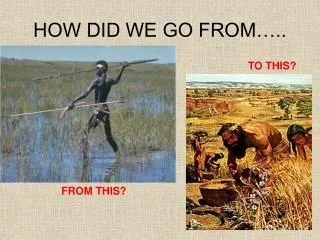
HOW DID WE GO FROM….. TO THIS? FROM THIS?
Why was it a NEOLITHIC REVOLUTION? CATAL HOYUK JERICHO
CATAL HOYUK • Evidence indicates that this settlement existed from c.7500 BCE to 5700 BCE . • Located in the Middle-East, in the country of Turkey. • It is believed that as many as 6,000 people lived in Catal Hoyuk.
CATAL HOYUK: Agriculture • Located on a high mound by the banks of the Carsamba river. • Flooded areas created marshland around the town (Spring). • Sediment from the river made land fertile. • Grew wheat, barley, lentils, chickpeas, berries, and nuts. • Raised flocks of sheep and herds of goats. They also kept dogs.
CATAL HOYUK: Shelter • Rectangular houses made of mud-dried bricks with high walls. • Entrance to each house was on the roof. • Entrance into each house was by ladder • Houses were joined together to provide protection for the town. • Movement within the town was done across the roofs.
CATAL HOYUK: Resources and Specialization • Animals hunted in the local mountains (wild boar, deer, leopards…), and birds hunted in surrounding marshland. • Fishing done in river. • Evidence of pottery-making. • Evidence of beer and wine making. • Obsidian (a volcanic, glassy rock) from local mountains was used to make tools. • Traded with other communities.
CATAL HUYUK: Culture • Evidence of religion: • Shrines* • Sculptures • Murals • Animal sacrifice • Burial practices • Types of gods: • Fertility goddess • Animal gods (Bull, Vultures…) *A building or place of worship.
JERICHO West Bank Jericho • Evidence indicates that this settlement existed from c.8500 BCE to 6000 BCE . • Located in the Middle-East, in the Occupied Territories (West Bank). • It is believed that as many as 3000 people lived in this community ISRAEL JORDAN
JERICHO: Agriculture • The town located near a natural oasis spring, which provided constant water source (1,000 gallons per hour). • Was also four miles away from the Jordan river. • Pipes and Canals made to move water to farmland. • Wheat, barley, peas, and lentils were grown, with sheep and goats raised for their meat and wool.
JERICHO: Shelter • Was situated on a large mound surrounded by massive stone walls, almost 12 feet in height, with a great, circular watchtower 30 feet tall. • Inside the walls were circular houses made of mud bricks. • Houses had as many as three rooms, with main room located underground (storage bins, hearth, baking ovens.)
JERICHO: Resources and Specialization • Gazelles, hares, wild boar, and birds were hunted in surrounding areas. • Fish taken from river. • Close to large supplies of salt, sulfur, and pitch. • Evidence of pottery making and basket-weaving. • Jericho located on an important trade route. • Traded goods found at Jericho: • obsidian (a volcanic, glassy rock) • cowrie shells • semi-precious stones
JERICHO: Culture • Evidence of ancestor worship: - Bodies buried beneath houses. - Skulls, plastered and painted so as to re-make the ancestor’s face. • Skulls kept in the homes on altars. • Evidence of religious shrines. - Areas of statues, and circles of skulls facing inwards.
Useful websites www.smm.org/catal/ www.jewishvirtuallibrary.org/jsource/vie/Jericho.html http://www.motherbird.com/jerichohst.html