Earth-Moon-Sun System
This guide explores the movements of the Earth, Moon, and Sun within our solar system. It covers key concepts such as Earth's rotation, which defines our day, and revolution, marking our year. The phases of the Moon and their relation to Earth, including waxing and waning, are explained alongside their impact on tides. Additionally, we discuss lunar and solar eclipses and the gravitational effects that create ocean bulges. This comprehensive overview reveals how these celestial bodies interact, influencing timekeeping and natural phenomena.

Earth-Moon-Sun System
E N D
Presentation Transcript
Rotation vs. Revolution • Rotation • The amount of time it takes for Earth to spin around once. • ONE DAY • Revolution • The amount of time it takes for Earth to go around the Sun once. • ONE YEAR
Movements in Orbit • Perigee • At its closest point in orbit • Object appears large • Apogee • At its farthest point in orbit • Object appears small
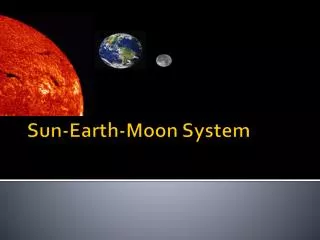
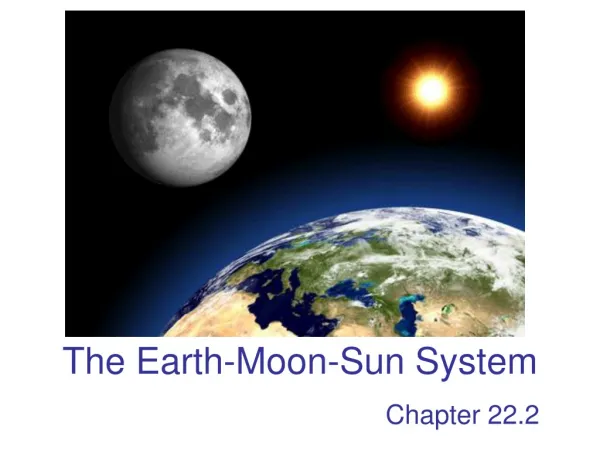
What do they all do? • Sun • Provides light, warmth • Source of most of energy that fuels our society • Moon • Raises tides in ocean • Illuminates sky with monthly cycle of phases
Daily Motions • Sun, moon, planets, and stars rise in east and set in west • Caused by Earth’s rotation
Rotation & Length of Day • Length of day is a little longer than the time it takes Earth to rotate once on its axis. • As Earth rotates, it also moves in its orbit • It has to turn a little farther • Solar Day • The time period from one sunrise or sunset to the next • Our timekeeping system is based on the solar day
Annual Motions • Length of day and temps may range depending on latitude • What is latitude? • Annual changes are due to Earth’s orbital motion around the Sun • Earth’s orbit is in an ecliptic plane • Oval-shaped
The Moon • Does not emit visible light • Reflection of the Sun’s light • Phases of the Moon • The changes of position in the sky is a result of the movement of the moon around the Earth • Lunar Phases • The sequential changes in appearance of the moon • Waxing • Increase in portion of sunlight side of the moon • Waning • Decrease in amount of sunlit side of the Moon
Phases of the Moon • New Moon • Moon is between Earth and Sun • Dark side of the moon faces Earth • Waxing Crescent • Less than half the lit portion during increase • First Quarter • Half the sunlit side during increase
Phases of the Moon (cont’d) • Waxing Gibbous • More than half of the lit portion during increase • Full Moon • Earth is between Moon and Sun • Can see entire sunlit side of moon • Waning Gibbous • More than half the lit portion during decrease
Phases of the Moon (cont’d) • Third Quarter • Half the sunlit side during decrease • Waning Crescent • Less than half the lit portion during decrease • New Moon • Beginning of cycle again
Moon Rotation • As the moon orbits, the same side always faces Earth at all times • It spins exactly once each time it orbits Earth • Lunar Month • The length of time it takes for 1 complete cycle of phases • About 29.5 days
Tides • The moon’s gravity pulls on Earth • Creates bulges of ocean water on near and far sides of Earth
Eclipses • Solar Eclipse • When the Moon passes directly between the Sun and Earth • Moon blocks out view of Sun • Lunar Eclipse • When the Moon passes through Earth’s shadow • Only occurs with there is a full moon