Exploring Trigonometric Equations: Finding Angles and Multiple Solutions
In this lesson on trigonometric equations, we focus on finding angles based on cosine ratios. We utilize graphical methods and reference angles to visualize solutions. The lesson emphasizes that multiple solutions often exist, stemming from the periodic nature of trigonometric functions. We also address inverse functions' role in solving for angles. Quadratic trigonometric equations are examined, with factoring and the quadratic formula as solution methods. Assignments and exercises reinforce understanding and application of these concepts.

Exploring Trigonometric Equations: Finding Angles and Multiple Solutions
E N D
Presentation Transcript
Trig Equations Lesson 3.6
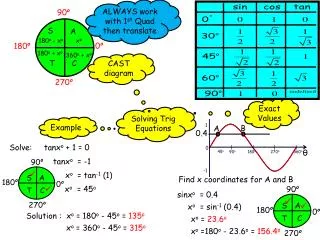
Find the Angle for the Ratio • Given the equation • We seek the angle (the value of x) for which the cosine gives the ratio • Answer can be foundGraphically Using Reference Angle 1 -1 2 2
Multiple Solutions • Note that many solutions often exist • Often we restrict the solution to the range of the inverse functions (see page 214) • The range of cos-1x … …
Note that @n1 signifies "some arbitrary integer" Multiple Solutions • Other solution methods • This gives us our multiple solutions
Multiple Solutions • Also possible to limit the domain of the answers • Then you don't get a representation of all possible answers
Using Inverse Functions • We can take the inverse cosine of both sides to solve the function
Quadratic Trig Equations • Usually they will factor Also possible to use the quadratic formula
Assignment • Lesson 3.6 – Assignment Part A • Page 278 • Exercises 1 – 59 EOO
Solving Angle of Inclination • Note the Excel spreadsheet, PumpkinElevation.xls • Use for problem 92, pg 267 • It uses the formula • Given a distance, we solve for θ
Modeling Sinusoidal Data Choo • Note sunset time for selected days of the year • Enter intodata matrix • Graph (zoomdata) • Use sin regression
Assignment • Lesson 3.6 Part B • Page 279 • Exercises 85-97 odd