Geostationary Microwave Observation System Simulation for Enhanced Weather Forecasting
This study presents simulation experiments to evaluate candidate geostationary microwave sensor concepts aiming to enhance National Weather Service (NWS) forecasting capabilities. Key goals include analyzing cost and performance trade-offs concerning regional-scale precipitation measurement, forecasting, and advanced all-weather temperature and humidity sounding with high temporal resolution. Additionally, the research explores the integration of geostationary microwave data into numerical weather prediction (NWP) models for improved hydrometric locking, alongside applications for AMSU-A/B radiance assimilation in support of collaborative atmospheric programs.

Geostationary Microwave Observation System Simulation for Enhanced Weather Forecasting
E N D
Presentation Transcript
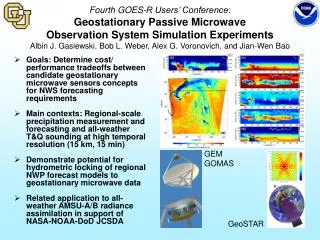
Fourth GOES-R Users’ Conference: Geostationary Passive Microwave Observation System Simulation ExperimentsAlbin J. Gasiewski, Bob L. Weber, Alex G. Voronovich, and Jian-Wen Bao • Goals: Determine cost/ performance tradeoffs between candidate geostationary microwave sensors concepts for NWS forecasting requirements • Main contexts: Regional-scale precipitation measurement and forecasting and all-weather T&Q sounding at high temporal resolution (15 km, 15 min) • Demonstrate potential for hydrometric locking of regional NWP forecast models to geostationary microwave data • Related application to all-weather AMSU-A/B radiance assimilation in support of NASA-NOAA-DoD JCSDA GEM GOMAS GeoSTAR