BUFFER OVERFLOW -Eswar Balasubramanian ECE578
110 likes | 262 Vues
This document explores the serious issue of buffer overflow vulnerabilities, with a focus on recent incidents, including 11 vulnerabilities identified in just one week. It explains the concept of buffer overflow, its exploitation through stack manipulation, and how malicious code can be executed by overwriting return addresses. The algorithm for executing such attacks is detailed, alongside practical examples of vulnerable code. Furthermore, preventive measures like using safer functions (strncpy, fgets) and implementing StackGuard and non-executable stack patches are discussed to safeguard against these vulnerabilities.


BUFFER OVERFLOW -Eswar Balasubramanian ECE578
E N D
Presentation Transcript
BUFFER OVERFLOW -Eswar Balasubramanian ECE578
Precursor How serious is this BO? • Number of Vulnerabilities in the past week – 11 • First Six vulnerabilities of 2002
Agenda • BO – what is it? • About the stack • Exploit • Prevention
Buffer Overflow • Copying more data into a buffer than it could hold char variable[10]; char safe[8] = “AAAAAAAA”; char unsafe[30] = “AAAAAAAAAAAAAAAAAAAAAAAAAAAAA”; strcpy(variable, safe); strcpy(variable, insafe);
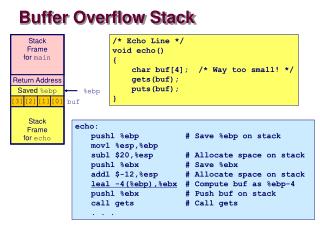
Stack • Used by Functions • Variables are allocated dynamically • esp and ebp adjusted accordingly • /* vulnerable.c */ • int main() • { • char buffer[500]; • gets(buffer); • return 0; • } • Ret from gets points to “return 0” sfp ret from gets esp buffer [500] ebp sfp [4] ret [4]
What Next? • To alter the return address to our liking • To place a tailor made code to do what we like [ buffer ] [sfp] [ret] [xxxxxxxxxx] [xxxx] [xxxx] 500 4 4 Algorithm: • Copy the big string into the buffer area to overflow the sfp and ret • Overflow the ret such that the return address points to the beginning of the buffer • Upon completion the program will return to the place pointed by ret, which is altered to point to the beginning of the buffer. • This buffer will contain the code to do something we like
To Do • Calculate return address • Construct large string • Return address calculated by finding the stack pointer of gets() • Subtract a guessed value from esp
String initially filled entirely with the ret address • Beginning of the string with NOPs (1/3) • Fill with the tailor-made code • Overflow the buffer (usually by passing as argument)
char buffer[SIZE]; ret = esp - offset; // fill buffer with ret addr's ptr = buffer; addr_ptr = (long *)ptr; for(i=0; i<SIZE; i+=4) *(addr_ptr++) = ret; // fill first half of buffer with NOPs for(i=0; i<SIZE/2; i++) buffer[i] = '\x90'; // insert shellcode in the middle ptr = buffer + ((SIZE/2) - (strlen(listDir)/2)); for(i=0; i<strlen(listDir); i++) *(ptr++) = listDir[i];
PREVENTION • Use strncat(), strncpy(), fgets() • StackGuard • Patch to make stack non-executable • Wrapper libraries