Download
1 / 31
310 likes | 414 Vues
Learn how Material Requirements Planning (MRP) ensures efficient production planning to meet future demand forecasts and orders. Explore the key concepts and inputs, such as demand sources, BOM, and material data.

E N D
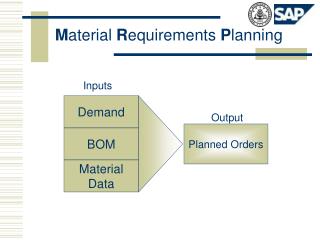
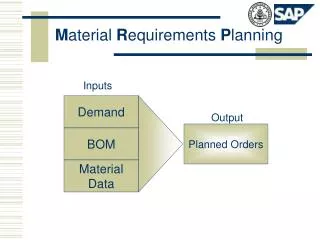
Demand BOM MaterialData Material Requirements Planning Inputs Output Planned Orders
Inputs Demand Output Planned Orders BOM MaterialData Material Requirements Planning • With MRP, production is planned to meet: • Future demand forecasts (make-to-stock) • Orders to be completed in the future (make-to-order or assemble-to-order) • A key input is, therefore, actual demand or a demand forecast MRP is a Push production system
Inputs Demand Output Planned Orders BOM MaterialData Material Requirements Planning • Planning • Sales and Operations Planning (SOP) • Forecasting, marketing plans, capacity • Profitability Analysis • Controlling (CO) Module (CO-PA) • Direct Input (Demand Management) Demand Sources
Demand Management • Simplest way to create demand it to input it directly:
Inputs Demand Output Planned Orders BOM MaterialData Material Requirements Planning • MRP uses the assembly structure, or Bill of Material (BOM) to determine how many components or subassemblies are needed to make the required number of finished products • Considers available inventory of components and subassemblies in calculations—net requirements MRP is designed for assembled products
Inputs Demand Output Planned Orders BOM MaterialData Material Requirements Planning • For end-items, demand is “independent”—from customers • For other components, demand can be determined using the BOM • Dependent demand MRP is designed for assembled products
Inputs Demand Output Planned Orders BOM MaterialData Material Requirements Planning ## NRG–A (7 cases) ## Dough NRG–A (500 lb) ## Oats (300 lb) ## Wheat Germ (50 lb) ## Raisins (50 lb) ## Carob Chips (50 lb)
Inputs Demand Output Planned Orders BOM MaterialData Material Requirements Planning Key MRP concept: Time-phased BOM ## NRG–A (7 cases) ## Dough NRG–A (500 lb) ## Oats (300 lb) ## Wheat Germ (50 lb) ## Raisins (50 lb) ## Carob Chips (50 lb) Time
## NRG–A (7 cases) ## Dough NRG–A (500 lb) Bill of Material (BOM)
## NRG–A (7 cases) ## Dough NRG–A (500 lb) Bill of Material (BOM)
## Dough NRG–A (500 lb) ## Oats (300 lb) ## Wheat Germ (50 lb) ## Cinnamon (5 lb) ## Nutmeg (2 lb) Bill of Material (BOM)
## Dough NRG–A (500 lb) ## Oats (300 lb) ## Wheat Germ (50 lb) ## Cinnamon (5 lb) ## Nutmeg (2 lb) Bill of Material (BOM)
Inputs Demand Output Planned Orders BOM MaterialData Material Requirements Planning Material Data determines production lot size and timing • Primary material data includes: • Current Inventory • Lot sizing procedure • Production lead times • All of this data is available in SAP via the Stock/Requirements List
Material Data—S/R List Inventory Level 0 Inventory Detail
Material Data—S/R List Lot Size FX, 7
Material Data—S/R List LeadTime 1
Part: A LS: 50 LT: 2 1 2 3 4 5 6 7 8 9 10 Gross Requirements 10 10 15 15 15 20 20 15 10 10 Scheduled Receipts 50 Planned Order Receipts 50 50 Available Balance 15 5 45 30 15 0 30 10 45 35 25 Planne d Order Releases 50 50 Textbook MRP Textbook MRP uses a bucketed system
Textbook MRP LS - lot size - size of production batch or lot sizing method Gross Requirements - quantity needed in each period - from MPS or from other components and assemblies Scheduled Receipts - Planned receipt dates for orders that have already been placed Planned Order Receipts - expected receipt date for planned orders (orders that haven't been placed yet) Available Balance - Projected inventory balance at the end of each period Planned Order Releases - Orders that need to be placed (as determined by MRP process) to meet gross requirements (source of planned order receipts)
Inventory Data Initial Scheduled Component LS LT Inventory Receipts A LFL 1 - 10 in pd. 1 B 50 2 30 50 in pd. 2 C 50 3 40 50 in pd. 3 30 in pd. 3 D 30 4 30 Textbook MRP—Example Problem