Effective Hamiltonian and CKM Matrix Elements in Quark Flavor Physics
This study focuses on obtaining the effective Hamiltonian to calculate the branching ratios in quark flavor physics, particularly how it relates to the CKM matrix elements. The unavoidable QCD effects in hadron decays are quantitatively addressed through Operator Product Expansion (OPE) and renormalization group (RG) techniques. The presentation of Light-Cone Sum Rules (LCSRs) offers a non-perturbative method for calculating form factors, considering both hard and soft gluon contributions simultaneously. It emphasizes the significant theoretical uncertainties inherent in these calculations.

Effective Hamiltonian and CKM Matrix Elements in Quark Flavor Physics
E N D
Presentation Transcript
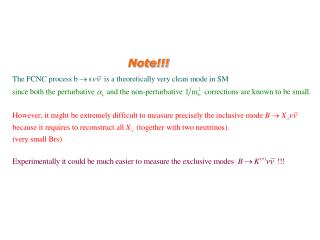
quark • neutrino We can obtain the effective Hamiltonian
We can calculate branching ratio with the effective Hamiltonian
The determination of the elements of the CKM matrix is one of the most important issues of quark flavor physics
Theory ( C.S.Kim, T.M. Aliev PRD58,013003(1998) ) • In SM • The effective Hamiltonian Note!!!
Since hadrons are involved in all the decays QCD effects are unavoidable and must be quantitatively understood. ⇒ OPE (Wilson and Zimmermann,1972) ⇒ RG ( ‘t Hooft, 1973 ; Weinberg, 1973 ) OPE (Operator Product Expansion ) Wilson(1969) proposed that the effects of the operator product could be computed by replacing the product of operators with a linear combination of local operators (OPE)
OPE (Operator Product Expansion ) Rev.Mod.Phys.68,1125(1996)
Theory ( C.S.Kim, T.M. Aliev PRD58,013003(1998) )
Theory ( C.S.Kim, T.M. Aliev PRD58,013003(1998) ) • Summarized the physics contributions to the amplitude A(B→F) from the scales lower than μ ( long distance contribution) • Non-perturbative !!! • Constitute the most important source of theoretical uncertainty
LCSRs (Light-Cone Sum Rules) • Extension of the original method of QCD sum rules devised by Shifman, Vainshtein and Zakharov (SVZ) • QCD sum rules on the light-cone allow the calculation of form factors in a kinetic regime where the final-state meson has large energy in the rest-system of the decaying B (large momentum transfer) • QCD sum rules combine the concepts of correlation functions and quark-hadron duality ingenuous way that allow the calculation of the properties of non-excited hadron states with a very reasonable theoretical uncertainty • LCSRs treat both hard and soft-gluon contribution on the same footing • Two different parton configuration 1. hard-gluon exchange ( factorizable ) : all quarks have large momenta and the momentum transfer happen via the exchange of a hard gluon 2. soft-gluon exchange ( non-factorizable ) : one quark is soft and interact with the other partons only via soft-gluon exchange • LCSRs rely on the factorization of the underlying correlation function into genuinely nonperturbative and universal hadron distribution amplitudes (DAs) Φ which are convoluted with process-dependent amplitudes T.
Theory ( C.S.Kim, T.M. Aliev PRD58,013003(1998) )
Theory ( C.S.Kim, T.M. Aliev PRD58,013003(1998) ) We have
Theory ( C.S.Kim, T.M. Aliev PRD58,013003(1998) ) We have
Numeric ( C.S.Kim, T.M. Aliev PRD58,013003(1998) ) ( P.Ball, R.Zwichy PRD71,014015(2005 )
Numeric ( C.S.Kim, T.M. Aliev PRD58,013003(1998) ) ( P.Ball, R.Zwichy PRD71,014029(2005 )
![NOTE : To appreciate this presentation [and ensure that it is not a mess ], you need Microsoft fonts: “Showcard Got](https://cdn0.slideserve.com/5700/slide1-dt.jpg)


![NOTE : To appreciate this presentation [and insure that it is not a mess ], you need Microsoft fonts: “Showcard Goth](https://cdn0.slideserve.com/784355/slide1-dt.jpg)