Gravity, Friction and Simple Machines
520 likes | 661 Vues
This resource explores core concepts of physics, including gravity, friction, and simple machines. Learn about Newton's laws of motion, the effects of air resistance, and how weight varies with location. Discover how friction operates in different contexts and why it can be both beneficial and detrimental. Additionally, engage with practical examples and calculations concerning work. This comprehensive guide equips learners with an understanding of how these forces interact and how simple machines can leverage these principles.


Gravity, Friction and Simple Machines
E N D
Presentation Transcript
Gravity, Friction and Simple Machines BY: BRIANNA SHIELDS
Do Now • 1. Which of Newton’s laws of motion explains inertia? • 2. Which type of atomic particle moves during static and current electricity? • 3. Which property of light allows it to bend as it passes through various types of matter?
GOAL • To relate gravity and weight • To define friction and air resistance and design ways to increase it or decrease it • To define work • To describe various simple machines
Gravity 1. Force of attraction-pulls things downward 2. Objects fall at a rate= 9.8 m/s2 acceleration due to gravity
Example 1 sec After falling for 7 seconds what is the acceleration of the ball? 2 sec 3 sec 4 sec 5 sec Speed of a falling object V = 9.8 x t (V= a(g) x t ) 6 sec 7 sec
Terminal Velocity Object no longer accelerates- it travels at a constant speed
Law of Universal Gravitation 1. All objects have gravity 2. Massive objects = greater gravity 3. Objects close together= more gravitational attraction
More Gravity Less Gravity Less Gravity More Gravity
Weight 1. Amount of gravity that pulls on an object Closer to core = more gravitational pull 2. Weight changes with location WEBSITE: Your weight on other worlds
Weight 3. W= m x 9.8 Weight= mass x acceleration due to gravity
Weight Calculations • What would a 10kg book weigh in newtons? • W = ma = 10kg x 9.8 m/s^2 = ? • What would a 50kg person weigh in newtons? • W = ma= 50kg x 9.8 m/s^’2 = ?
If a feather and a hammer are dropped at the same time, which will hit the ground first?
Air resistance Prevents objects from falling at 9.8 m/s Slows objects down Object rubs against air molecules Pushes upward on objects Due to object’s shape Why does the hammer hit the ground before the feather?
If a feather and a hammer are dropped at the same time on the moon, which will hit the ground first? Find out by watching “Brain Bytes” NASA Vodcast
Friction 1. Exists Where 2 surfaces touch 2. Acts in direction opposite to object’s motion
Friction acting on an incline • Often, picking up a heavy object is actually easier than trying to slide it across the floor Pushing FRICTION
Types of friction 1. Sliding- produced when solid objects slide over each other 2. Rolling Friction- produced by wheels 3. Fluid friction- created when an object moves through/across a fluid (water, oil or air)
Examples of Friction • Come up with atleast two examples of each friction: sliding, rolling and fluid • Come up with atleast two examples during which friction would be helpful
Label with the type of friction: Rolling Friction
Label with the type of friction: Fluid Friction
Label with the type of friction: • The movement of lubricated engine parts
Label with the type of friction: Rolling Friction
Label with the type of friction: Rolling Friction
Label with the type of friction: Sliding Friction
Label with the type of friction: Fluid Friction
Compare these two animations. How can the differences be explained? With air resistance Without air resistance
No Gravity: What will happen when the banana is shot from the cannon?
With Gravity: What will happen when the banana is shot from the cannon?
You will view a photograph of two balls being released from an apparatus. Which will hit the ground first? The one dropped straight down or the one shot out sideways?Website: http://www.fearofphysics.com/XYIndep/xyindep.html
Projectile Motion Tutorial Online: http://www.mhhe.com/physsci/physical/giambattista/proj/projectile.html
Work A force acting through a distance to move an object Must be moved over a distance Object must move in direction of force Work = force x distance
Work Examples Pushing a desk Throwing a baseball Lifting a shovel Not Examples Carrying a grocery bag Pushing on a wall Carrying a shovelful of snow
Work or Not??? Explain • Picking up a grocery bag • Carrying a grocery bag to the door • Throwing a baseball 20 meters • Lifting a suitcase to put into the overhead luggage compartment • Pushing against a cement slab until exhausted
Work or Not??? Explain • Carrying a bag of cat litter home from the store • Slamming a tennis ball across the net • Studying all night for the science test • Finger pushing down the RETURN key on a computer
Work or Not??? Explain • Carrying a shovel full of snow from the driveway to the lawn • You and a friend pushing a heavy piano across a wooden floor • Standing for half and hour in the freezing cold waiting for the bus to come
Work Example • If you lifted an object weighing 200 N through a distance of 0.5 m, how much work would you do? • W = F x D = 200N x 0.5m = 100nm
Work Example • If you picked up a rock weighing 350 N for a distance of 1.0m, how much work would you do? • W = F x D = 350N x 1.0m = 210 nm
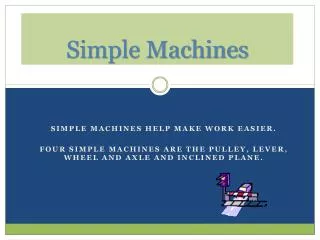
What do machines do? Change small forces into large forces Allow small forces to move large objects Change the size and direction of the force Doesn’t reduce work- divides it into smaller jobs
Inclined plane Ramp, slanted surface Ex: truck ramp
Wedge Moving inclined plane with edges Ex: knife, scissors, key
Screw Bar wrapped with threads for fastening Ex: Lightbulb Jar Lid
Lever Bar that pivots up and down Ex: hammer, teeter toter
Pulley Rope wrapped around a wheel Ex: window shade pull
Wheel and axle 2 different sized spinning circles Ex: fan, sawblade, screwdriver
Machine Assessment • Work with your group members to create your own examples (atleast two) for each machine: • Pulley • Lever • Wedge • Screw • Inclined plane • Wheel and axle