The Power of Imagery in Poetry: Engaging the Senses
Imagery in poetry evokes vivid sensory experiences, almost mirroring the effects of directly stimulating our senses. Each poetic line serves as an image, with the power to convey complex feelings and pictures, often more effectively than mere words. This exploration highlights various types of imagery—visual, auditory, and tactile—illustrating how they deepen our understanding and connection to the poem. From mental pictures to sounds and tactile sensations, poets craft intricate worlds that linger in the mind, demonstrating the profound impact of sensory language.

The Power of Imagery in Poetry: Engaging the Senses
E N D
Presentation Transcript
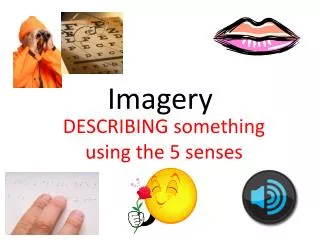
Imagery • A poem has its power to produce in the mind an effect very nearly the same as that created by stimulation of the sensory organs. • Each line of a poem contains an image, which , like a picture, may take the place of a thousand words • Though the term images suggests a thing seen, when speaking of images we generally mean a word or sequence of words that refers to any sensory experience
Imagery An image may occur in a single word, a phrase, a sentence, or in this case, an entire short poem. To speak of the imagery of a poem—all its images taken together—is often more useful than to speak of separate images.
Imagery • Visual imagery • Auditory imagery • Tactile imagery
Visual Imagery • We speak of mental pictures; we mean an effect in the mind much like that produced by our perceiving a visible object through the eye, the optic nerve, and the appropriate regions of the brain.`
Example of visual imagery in a poem from The Eve of St.Agnes A casement high and triple-arched there was All garland with carven imag’ries Of fruits, and flowers, and bunches of knot-grass And diamonded with panes of quaint device Innumerable of stains and splendid dyes As are the tiger-moth’s deep-damasked wings;
Auditory imagery • Auditory imagery is fairly frequently used by a poet • It may be produced by the naming and describing of sounds
Example of auditory imagery • John Keats reinforces auditory imagery by imitating natural sounds in the sounds of his words: The silver,snarling trumpets’ gan to chide… …meantime the frost-wind blows Like love’s alarum pattering the sharp sleet Against the window-panes….
Tactile imagery • Poetry also appeals the sense of feeling that produce tactile images. • Tactile imagery refers to images produced bye sense of feeling from the words in poem that deals with a touch (as a perception of roughness or smoothness) • It may be an odor or a taste or perhaps a bodily sensation such as pain, the quenching of thirst etc
Example of tactile imagery • These lines from another stanza of “The Eve of St. Agnes” contain images appealing to what we closely call the sense of feeling: Soon trembling in her soft and chilly-nest In sort of wakeful swoon, preplexed she lay Until the poppied warmth of sleep oppressed Her soothed limbs, and soul fatigued away…..