Download
1 / 9
90 likes | 217 Vues
This session wraps up the key insights from Week 6 of the Ante-Law School Camp, focusing on empowering law students to effectively evaluate and engage with legal readings. It presents strategies such as reading with purpose, using notes to capture thoughts, and adjusting reading techniques based on circumstances. Participants will explore the importance of understanding their own biases, the writing styles of judges, and how to leverage their prior knowledge for better comprehension. Learn to monitor your reading and connect ideas for a more constructive learning experience.

E N D
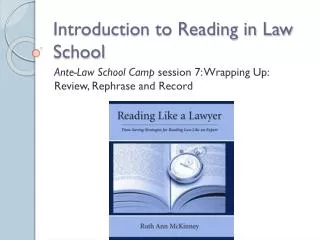
Introduction to Reading in Law School Ante-Law School Camp session 7: Wrapping Up: Review, Rephrase and Record
Recap of Week 6: • empowEr • Evaluate What You’re Reading: Your Ideas Matter • Evaluating • Before Reading • External distracters thoughts and feelings re: life • Thoughts and feelings re: reading subject matter • While Reading • Judges’ writing styles • Judges’ biases and presumptions • After Reading • Intellectual content of reading • Relationship to past and future reading • Learning is a recursive and constructive process
Today: empoweR • Engage with Energy • Monitor Your Reading and Read for the Main Idea • Always (Always!) Read with a Purpose • Get Oriented and Own Your Prior Knowledge and Experience • There’s More to the “Five Ws” (Who, What, When, Where and Why) Than Meets the Eye • Evaluate What You’re Reading: Your Ideas Matter • Review, Rephrase, Record
Review, Rephrase & Record • Discovering the key (“magic”) words of legal discourse • Takes advantage of the natural processes of memory • Short term • Working • Long term • Note-taking & Case-briefing
Review, Rephrase & Record (cont’d) • “The best highlighting in the world can only capture the author’s words. You also need to read with a pen or pencil at your side so that you capture your own thoughts and reactions to what you are reading.” • Writing down thoughts forces conscious attention, and with it evaluation, of what you do and don’t know about a subject.
Leonard v. Pepsico EMPOWER E- (energy assessment) M- main idea & monitoring P- purpose O- owning prior knowledge & orient W- who, what, when, where, why & how E- evaluate R- review, rephrase, record
Casebook Reading Reviewed • DO • Engage in a conversation with the writer of the text you’re reading • Monitor yourself as you read • Know why you’re reading • Modify your reading techniques to circumstances • Pay attention to knowledge and knowledge gaps • Use case-briefing to help chunk information for more efficient processing • Have opinions • Be flexible • Rephrase to reach understanding • Use your knowledge of memory to optimize your study efforts • Work towards a “big picture”
EMPOWER • Engage with Energy • Monitor Your Reading and Read for the Main Idea • Always (Always!) Read with a Purpose • Get Oriented and Own Your Prior Knowledge and Experience • There’s More to the “Five Ws” (Who, What, When, Where and Why) Than Meets the Eye • Evaluate What You’re Reading: Your Ideas Matter • Review, Rephrase, Record
Resources • Ruth Ann McKinney, Reading Like a Lawyer: Time-Saving Strategies for Reading Law Like an Expert