Download
1 / 30
300 likes | 426 Vues
Explore the ancient civilizations of the Middle East, often called "The Cradle of Civilization," which served as a crossroads for three continents. Discover how factors such as urban centers for trade, advanced record keeping (like cuneiform), specialized jobs, and governance institutions shaped societies into civilizations. Key players include the Sumerians and Babylonians, whose innovations in writing, law (as seen in the Code of Hammurabi), and trade paved the way for more complex societies. This overview delves into their culture, technologies, and significant historical events.

E N D
The Ancient Civilizations
Indo-European Migrations: 4m-2m BC The Middle East: “The Crossroads of Three Continents”
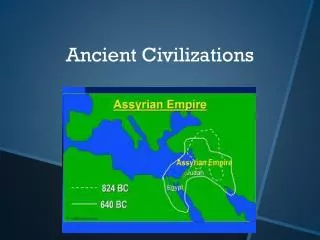
The Ancient Fertile Crescent Area The Middle East: “The Cradle of Civilization”
What is a Civilization? an advanced state of human society, in which a high level of culture, science, industry, and government has been reached.
What does a society need in order to be called a Civilization? Cities as centers for trade Record Keeping a form of writing Specialized Jobs and skilled workers Institutions- Government, Religion, Education Advanced Technologies and Tools
Cities as centers for trade A place for people to bring things to trade for other items Protection, Culture, Easier life
Record Keeping - Writing Babylonian - Cuneiform Inca-Quipu Egyptian hieroglyphics
Specialized Jobs Jewelry Maker Scribes Farmers Mr. Edge Stone Mason Military Al Asad, Iraq
Religion Institutions Government Code of Hammurabi E D U C A T I O N
Sumerian Religion - Polytheistic Enki Innana Anthropomorphic Gods
Mesopotamian Trade “The Cuneiform World”
Sumerian Scribes “Tablet House”
Ziggurat at Ur • Temple • “Mountain of the Gods”