Expert Digital Transformation Services Saudi, Canada
0 likes | 13 Vues
Transform your business with our expert digital transformation services in saudi. Leverage cutting-edge technology, automation, and data-driven strategies to optimize operations, boost efficiency, and drive sustainable growth.


Expert Digital Transformation Services Saudi, Canada
E N D
Presentation Transcript
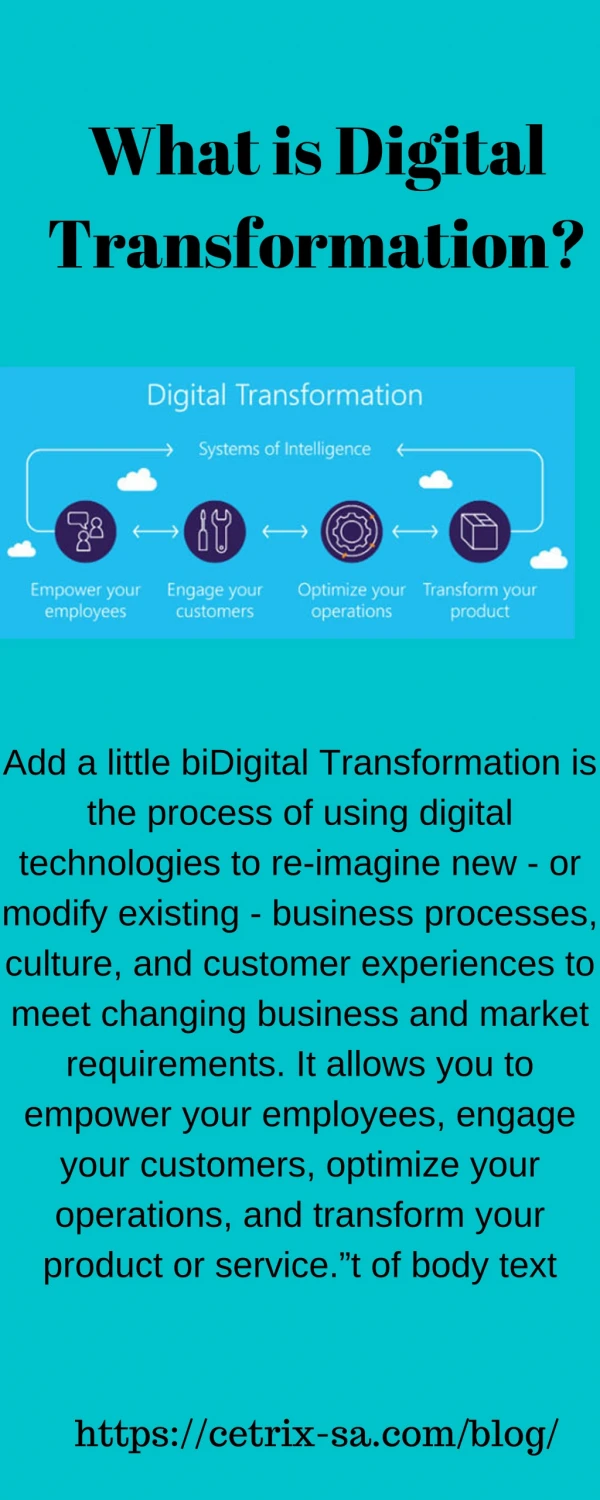
Unlocking Business Growth with Digital Transformation Services In today’s hyper-competitive business environment, organizations must embrace change or risk being left behind. Digital transformation is no longer a luxury; it’s a necessity. Digital transformation services provide businesses with the tools, strategies, and technologies to evolve, innovate, and streamline their operations. This journey isn't just about technology; it's about reshaping the way companies engage with customers, manage their processes, and drive value in the digital age. What is Digital Transformation? At its core, digital transformation is the integration of digital technologies into all aspects of a business, fundamentally changing how it operates and delivers value. It involves using new tools and strategies to improve customer experiences, enhance internal processes, and create new business models that leverage digital opportunities. From cloud computing and artificial intelligence (AI) to data analytics and automation, digital transformation services help organizations adapt to the modern digital landscape, ensuring they remain competitive and agile. It’s about making smarter decisions faster, improving business efficiency, and responding more quickly to market demands. Key Benefits of Digital Transformation Services Digital transformation offers several advantages for businesses, making them more efficient, customer-centric, and agile. Here are the key benefits: 1. Enhanced Customer Experience In a world where customers expect personalized, seamless, and on-demand experiences, digital transformation helps businesses meet these demands. By leveraging data analytics, AI, and automation, organizations can offer tailored products and services, engage with customers across multiple channels, and provide exceptional customer support. 2. Improved Operational Efficiency Digital transformation services enable companies to automate manual processes, streamline workflows, and eliminate inefficiencies. For example, automating administrative tasks or implementing AI-powered solutions for predictive analytics can help organizations save time, reduce errors, and optimize resources.
3. Better Decision-Making through Data Insights The ability to collect, analyze, and interpret data in real time is one of the core advantages of digital transformation. With data-driven insights, businesses can make more informed decisions, predict trends, and optimize strategies. This can lead to improved product offerings, more effective marketing, and optimized customer interactions. 4. Increased Agility and Innovation Digital transformation helps businesses become more agile by enabling them to quickly adapt to changing market conditions and customer preferences. By adopting cloud solutions, DevOps, and flexible IT infrastructure, organizations can test new ideas faster, scale operations quickly, and innovate without being constrained by legacy systems. 5. Cost Reduction and Scalability Cloud computing, automation, and integrated systems enable businesses to scale their operations more efficiently. This reduces the need for expensive hardware, improves cost management, and allows organizations to pay for only the resources they need. Digital transformation services help businesses optimize their processes to achieve significant cost savings. The Digital Transformation Process Embarking on a digital transformation journey involves several stages, each of which plays a crucial role in achieving the desired outcomes. Here’s a general overview of the process: 1. Assessment and Strategy Development The first step in digital transformation is a thorough assessment of your current business operations. This involves identifying inefficiencies, understanding customer pain points, and analyzing data to uncover opportunities for improvement. Based on this assessment, a comprehensive digital transformation strategy is developed to align with business goals and objectives. 2. Choosing the Right Technologies Technology selection is critical to the success of digital transformation. Whether it’s cloud computing, AI, IoT (Internet of Things), machine learning, or automation, businesses need the right tools to support their transformation journey. Service
providers help businesses choose and integrate the most relevant technologies based on their needs and future goals. 3. Implementing Change and Integration This stage involves integrating new systems and technologies into the business. This could include cloud migration, upgrading legacy systems, automating processes, or implementing AI and analytics solutions. The integration must be seamless to minimize disruptions and ensure that business operations continue to run smoothly. 4. Training and Change Management Digital transformation often involves a cultural shift within the organization. Employees need to be trained on new technologies and processes. Change management initiatives ensure that the workforce is prepared for the transition, adopting new tools and technologies with ease. 5. Continuous Improvement and Monitoring Digital transformation is an ongoing process, not a one-time event. Businesses must continuously monitor the effectiveness of their digital strategies and make adjustments as needed. This includes tracking performance metrics, analyzing customer feedback, and staying up-to-date with the latest technological advancements to maintain competitiveness. Key Technologies Driving Digital Transformation Several emerging technologies are playing a significant role in the digital transformation of businesses. These technologies help organizations improve efficiency, deliver innovative products, and enhance customer experiences: • Cloud Computing: Cloud solutions offer businesses flexibility, scalability, and cost-efficiency by enabling them to store data and run applications on remote servers rather than on- premise hardware. • Artificial Intelligence (AI) and Machine Learning (ML): AI and ML allow businesses to automate processes, gain deeper insights from data, and enhance decision-making. AI- powered chatbots and recommendation systems are just a few examples of how AI is revolutionizing customer service. • Big Data and Analytics: With the ability to collect and analyze massive amounts of data, businesses can uncover actionable insights to drive decisions, predict trends, and improve products and services.
• Internet of Things (IoT): IoT devices help businesses monitor and control physical assets in real-time, leading to better resource management, predictive maintenance, and improved customer experiences. Industries That Benefit from Digital Transformation Digital transformation has the potential to transform almost any industry. Some key sectors that are experiencing significant change due to digital transformation services include: • Healthcare: Digital transformation in healthcare includes telemedicine, AI-powered diagnostics, electronic health records (EHR), and wearable health monitoring devices that improve patient care and operational efficiency. • Retail: Retailers are using digital transformation to offer personalized shopping experiences, optimize inventory management, and integrate omnichannel solutions for better customer service. • Manufacturing: Industry 4.0 is driving the adoption of IoT, robotics, and automation in manufacturing, improving efficiency, reducing downtime, and enabling predictive maintenance. • Finance: In the financial services industry, digital transformation is enhancing customer experience through mobile banking, improving fraud detection with AI, and streamlining operations through automation. • Education: Digital learning platforms, virtual classrooms, and e-learning tools are reshaping education, offering more flexible and personalized learning experiences. Conclusion Digital transformation is not just about adopting new technologies; it’s about rethinking how businesses operate, engage with customers, and deliver value. By embracing digital transformation services, companies can streamline processes, enhance customer experiences, and innovate at a faster pace. In an era of constant change, digital transformation is essential for businesses that want to remain competitive and drive growth. Whether it’s through adopting cloud computing, AI, data analytics, or automation, businesses must continue evolving to stay ahead of the curve.