USMLE Step 1 Study Schedule
USMLE Step 1 Study Schedule

USMLE Step 1 Study Schedule
E N D
Presentation Transcript
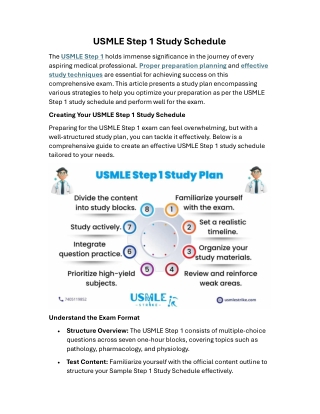
USMLE Step 1 Study Schedule The USMLE Step 1 holds immense significance in the journey of every aspiring medical professional. Proper preparation planning and e?ective study techniques are essential for achieving success on this comprehensive exam. This article presents a study plan encompassing various strategies to help you optimize your preparation as per the USMLE Step 1 study schedule and perform well for the exam. Creating Your USMLE Step 1 Study Schedule Preparing for the USMLE Step 1 exam can feel overwhelming, but with a well-structured study plan, you can tackle it e?ectively. Below is a comprehensive guide to create an e?ective USMLE Step 1 study schedule tailored to your needs. Understand the Exam Format Structure Overview: The USMLE Step 1 consists of multiple-choice questions across seven one-hour blocks, covering topics such as pathology, pharmacology, and physiology. Test Content: Familiarize yourself with the o?icial content outline to structure your Sample Step 1 Study Schedule e?ectively.
Focus on High-Yield Topics: Prioritize high-yield topics like biochemistry and pathology, as they form the core of the exam. Assess Your Current Knowledge Take a Diagnostic Test: Begin with an NBME self-assessment to identify strong and weak areas. Categorize Subjects: Rank subjects from strongest to weakest for a customized USMLE Step 1 Study Plan. Adjust Accordingly: Allocate extra time in your schedule for topics where improvement is needed. Set Clear Goals Define Objectives: Set achievable goals for daily, weekly, and monthly study milestones. Track Progress: Use a study planner or app to monitor your progress and make necessary adjustments. Plan for Flexibility: Include bu?er days in your Sample Step 1 Study Schedule to accommodate unexpected interruptions. Design Your Study Schedule Daily Structure: Break your day into study blocks (e.g., 2-hour sessions with 10–15 minute breaks). Weekly Plan: Dedicate specific days to particular subjects, ensuring balanced coverage. Revision Days: Reserve weekends for reviewing previously covered material. Choose Study Resources Top Resources: oUSMLEStrike: A modern platform providing step-by-step study plans, curated guides, and exam-focused strategies to complement your preparation. oUWorld: The go-to question bank for in-depth learning and application. Treat it as a study guide, not a test.
oPathoma: Ideal for understanding core pathophysiology with a focus on high-yield topics. oAnki: Use premade decks for spaced repetition to enhance memory retention over time. oPixorize: Excellent for visualizing complex biochemistry and metabolism pathways. oSketchy Medical: Great for microbiology and pharmacology using visual mnemonics for lasting recall. Combine Tools: Incorporate flashcards, videos, and practice exams to enhance retention. Stick to Reliable Materials: Avoid overloading with too many resources; consistency is key for your USMLE Step 1 Study Plan. Be Consistent With Your Schedule Follow a Routine: Stick to your USMLE Step 1 Study Schedule daily to maintain momentum. Avoid Burnout: Include exercise, relaxation, and adequate sleep in your routine. Stay Motivated: Reward yourself for achieving study goals to keep up morale. Find a Study Partner or Form Study Groups Collaborating with peers who share the same goals can enhance your learning experience. Join or form study groups to discuss challenging concepts, share study resources, and teach one another. A study partner who focuses on the USMLE Step 1 study schedule can provide motivation and accountability, making the studying process more enjoyable and e?icient. Subject-Based Review Subject-based review involves a methodical study approach where USMLE Step 1 study plan candidates tackle the exam’s vast content by focusing on one subject or organ system at a time.
This strategy facilitates an in-depth understanding of anatomy, physiology, pathology, and pharmacology within each subject. By integrating concepts and emphasizing interconnections between organ systems, candidates develop a holistic comprehension. Sample Step 1 Study Schedule During the Day (around 8am to 5pm): Morning: Begin with a set of 40 practice questions, aiming to complete them within an hour. Spend an additional 2-3 hours thoroughly reviewing these questions, aiming for a maximum of 4 hours. Initially, focus on completing these questions in tutor mode, allowing time to digest explanations and create flashcards. Over the course of the 10-week study guide, gradually transition towards completing more questions in timed mode. Afternoon: Dive into topic-specific content using supplementary materials such as videos, texts, or QBank questions. Repetition is key to solidifying your understanding, so ensure to allocate su?icient time for this step. Late Afternoon: Dedicate time to revisiting weaker topics identified during your review sessions. In the Evening (approximately 7pm to 9pm): Continue content review using supplemental resources, gradually shifting towards focusing on QBank questions in later weeks. Incorporate flashcard review into your evening routine, dedicating at least an hour each night to reinforce your learning. Assessments: The initial baseline assessment serves to familiarize you with the USMLE format but holds less significance compared to the 5-week study plan. It provides a benchmark for comparison. The following 5 assessments are crucial for exposing you to real testing conditions and objectively tracking your progress. Use these assessments to manage your study time, fatigue, and stress e?ectively.
Reflect briefly on your progress at the end of week 6, after completing your fourth assessment. Have your practice scores improved? Do you feel more confident approaching questions? If not, consider adjusting your study plan for the final 4 weeks to optimize your chances of success. Tips from the Best USMLE Tutors Focus on high-yield topics: Spend more time on frequently tested topics like Microbiology, Pharmacology, and Pathology. Active learning: Don’t just read. Engage actively by using flashcards, drawing pathways, or teaching others. Consistent practice: Allocate at least 50% of your study time to doing and reviewing practice questions. UWorld and NBME question banks are your best friends. Stay organized: Use a planner or app to track daily goals and progress. This ensures you stay on top of your USMLE Step 1 Study Schedule. 1-Month USMLE Step 1 Study Plan For students short on time, a 1-month USMLE Step 1 Study Schedule requires intense focus. Here’s a structured plan: Day Topics Resources Practice Day 1-5 Biochemistry & Genetics USMLEStrike, First Aid, Pathoma, Anki UWorld (50 questions/day) USMLEStrike, SketchyMicro, First Aid, Anki Day 6-10 Microbiology & Immunology UWorld (50 questions/day)
Day 11-15 USMLEStrike, First Aid, Lange, Anki UWorld (50 questions/day) Pharmacology Day 16-20 USMLEStrike, BRS Physiology, First Aid UWorld (50 questions/day) Physiology Day 21-25 Pathology & Anatomy USMLEStrike, Pathoma, First Aid UWorld (50 questions/day) Day 26-30 Full review & practice exams USMLEStrike, First Aid, NBME practice exams UWorld (80 questions/day) 3-Month USMLE Step 1 Study Plan This plan o?ers a balanced approach, allowing more time to master content. Here’s your 3-month USMLE Step 1 Study Schedule: Week Topics Resources Practice USMLEStrike, First Aid, Kaplan videos, Anki Week 1-2 Biochemistry & Molecular Biology UWorld (30 questions/day) USMLEStrike, SketchyMicro, First Aid Week 3-4 Microbiology & Immunology UWorld (30 questions/day)
Week 5-6 Pharmacology & Physiology USMLEStrike, Kaplan, BRS, First Aid UWorld (40 questions/day) USMLEStrike, Pathoma, First Aid, Anki Week 7-8 UWorld (40 questions/day) Pathology Anatomy, Embryology & Behavioral Week 9-10 USMLEStrike, First Aid, Kaplan videos UWorld (50 questions/day) USMLEStrike, First Aid, UWorld, NBME exams Week 11-12 Full review and mock exams UWorld (60 questions/day) 6-Month USMLE Step 1 Study Plan For those starting early, a 6-month USMLE Step 1 Study Schedule o?ers flexibility to deepen your understanding of each subject. Topics Resources Practice Month Month 1 Biochemistry & Genetics USMLEStrike, Kaplan books, Anki, First Aid UWorld (20 questions/day) Month 2 Microbiology & Immunology UWorld (20 questions/day) USMLEStrike,
SketchyMicro, First Aid, Anki USMLEStrike, Pathoma, First Aid, Kaplan Month 3 Pharmacology & Pathology UWorld (30 questions/day) Physiology, Anatomy & Embryology USMLEStrike, BRS Physiology, Kaplan, First Aid Month 4 UWorld (30 questions/day) Month 5 Behavioral Science & Biostatistics USMLEStrike, First Aid, Anki, Kaplan UWorld (40 questions/day) Month 6 Full review & practice exams USMLEStrike, First Aid, NBME, UWorld UWorld (50 questions/day) Preparatory Phase & Revision Phase Preparatory Phase This phase should constitute approximately 75% of your total preparation time. Goal: To learn and master the facts, concepts, and their applications for each topic/subject. Consider the various ways a fact/concept could be tested. Resources USMLEStrike First Aid for the USMLE Step 1 Additional resources
UWorld Strategy First Aid: Use it as your primary guide. Don’t just read; aim to thoroughly understand and master the content. Complete one full pass of First Aid by the end of this phase. Additional Resources: Utilize these to grasp complex concepts and scientific principles. Take necessary notes and integrate them into your First Aid book or a separate notebook, creating a comprehensive ‘GO TO’ resource for revision. UWorld: Start using UWorld Step 1 from the beginning to learn the application of knowledge and develop test-taking skills. Solve and review questions daily, completing one full pass by the end of this phase. UWorld Journal: Maintain a journal to take notes on essential concepts and facts from UWorld questions. This will be a valuable resource for quick revision before the exam. Revision Phase This phase should make up about 25% of your total preparation time. Goal: To revisit all the facts and concepts learned during the preparatory phase and hone your test-taking skills. Resources First Aid Notes from additional resources UWorld UWorld Journal NBME Assessments UWSAs Strategy
Second Pass of UWorld: Solve and review 80-100 questions daily. Practice completing one question block (40 questions) in 45-50 minutes to simulate test conditions. Revise UWorld Journal: Regularly revisit the notes you’ve taken. Second Pass of First Aid: Thoroughly review First Aid and your notes from additional resources. NBME Assessments: Take an NBME assessment at the beginning of this phase to identify areas of weakness. Revise and improve based on feedback. Continue taking and reviewing NBMEs and UWSAs weekly. Simulated Exams: Take two, four-hour assessments online consecutively to mimic the actual eight-hour Step 1 exam. This should be done at least once during the revision phase, solving question blocks and taking breaks as you would on exam day. Conclusion Preparing for Step 1 requires discipline, organization, and e?ective study techniques. By understanding the exam format, creating a realistic study schedule, and staying consistent, adapt USMLE Step 1 study schedule as planned, and approach the exam with confidence. Good luck! For more details visit https://usmlestrike.com/highest-paying-countries-for-doctors/

![[DOWNLOAD] Marketing Made Simple: A Step-By-Step Storybrand Guide for Any Business Full](https://cdn5.slideserve.com/11106317/slide1-dt.jpg)
![Download Book [PDF] Deja Review USMLE Step 1 3e](https://cdn7.slideserve.com/12500322/slide1-dt.jpg)
![[PDF] Master the Boards USMLE Step 2 CK, Seventh Edition Ipad](https://cdn7.slideserve.com/12515907/slide1-dt.jpg)