Understanding the Campus Security Act: Requirements and Reporting for Safety
The Campus Security Act, also known as the Clery Act, is a crucial federal law enacted to ensure that colleges and universities provide timely crime warnings and maintain transparency about campus safety. This law mandates institutions to publish annual reports containing security policies and crime statistics from the past three years. Named after Jeanne Ann Clery, a victim of campus crime, the Act requires designated Campus Security Authorities to report allegations of crimes and keep the campus community informed. Non-compliance can lead to fines from the Department of Education.

Understanding the Campus Security Act: Requirements and Reporting for Safety
E N D
Presentation Transcript
Campus Security Act October 1, 2010
What Are We Going To Cover? • What is it? • History • “Campus Security Authority” • Reporting Requirements • Changes • Campus Security Report
Campus Security Act • The Campus Security or “Clery” Act is a federal law that requires colleges and universities to give timely warning of crimes that represent a threat • Make public campus security policies • Maintain a public crime log. • Crime data must be collected, reported, & disseminated to campus community & U.S. Department of Education
Campus Security Act (cont.) • Publish an annual report disclosing campus security policies & last 3 years selected crime statistics. • U.S. Department of Education collects and disseminates the crime statistics. • Failure to comply, can be fined by the DOE. • Very specific requirements on how all of this is done
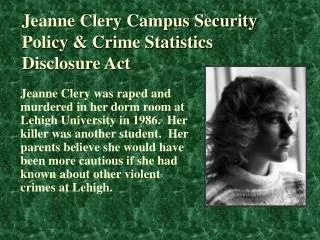
History • Named in memory of 19 year old Lehigh University freshman Jeanne Ann Clery who was murdered while asleep in her residence hall room on April 1986. • Parents discovered that students hadn't been told about violent crimes on campus. • Congress to enacted this law in 1990 • Law was amended in 1992, 1998, 2000, and 2008, and 2009
Campus Security Authority? • Not just the police or campus security • “an official of the college who has significant responsibility for student and campus activities…” • An “official” is a person who has the authority & duty to take action or respond to issues on behalf of the institution • Examples: dean, director, coach, a faculty advisor
I am one? What do I have to do? • Report allegations of crimes made in “good faith” to Campus Security • Need to be done quickly • Only two exceptions: • Pastoral counselor • Professional counselor who is functioning within the scope of their license
Reporting • If you observe, or anyone reveals to you they were the victim, perpetrator, or witness to any crimes listed, report the information to Campus Security. • If in doubt, err on the side of reporting • It does not matter whether an arrest was made
Crimes to be Reported • Murder • Manslaughter • Sex offenses, forcible & non-forcible • Robbery • Aggravated assault • Burglary • Motor vehicle theft • Arson • Hate crimes involving bodily injury, larceny/theft, simple assault, intimidation or vandalism • Liquor, drug, or weapon law violations resulting in an arrest or referral for campus discipline
Campus Security Act Report • Available on the web: www.kirkwood.edu/security