Download
1 / 40
400 likes | 534 Vues
This research explores the effects of isospin mixing and parity violation in electron scattering processes, particularly in N=Z nuclei like 12C, 24Mg, 28Si, and 32S. We present a theoretical framework that includes nucleon strangeness content, Coulomb distortion, and nuclear deformation effects on parity-violating asymmetry. Through Hartree-Fock and BCS methods, we examine the implications for standard model coupling constants, neutron distributions, and outline the experimental feasibility of maximizing asymmetry deviations. Our findings highlight significant deviations compared to previous calculations, emphasizing the role of major shell structures.

E N D
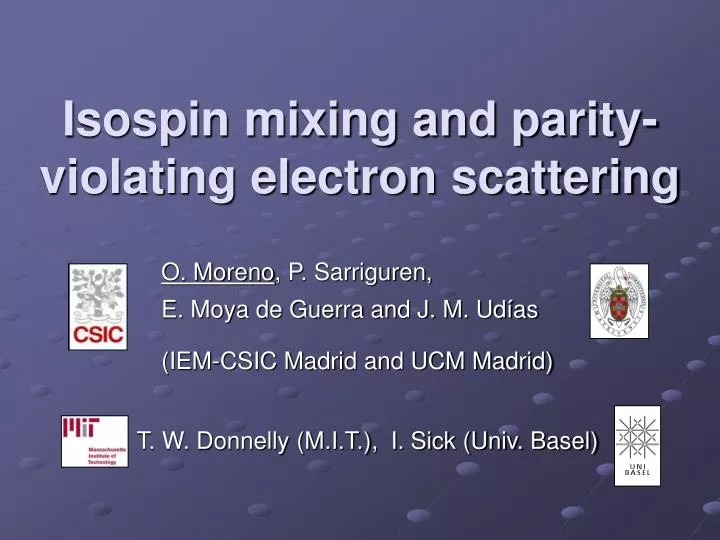
Isospin mixing and parity-violating electron scattering O. Moreno, P. Sarriguren, E. Moya de Guerra and J. M. Udías (IEM-CSIC Madrid and UCM Madrid) T. W. Donnelly (M.I.T.), I. Sick (Univ. Basel)
Summary IntroductionTheoretical frameworkResultsConclusions
(PWBA) Introduction: parity violation in electron scattering Standard Model coupling constantsNucleon strangeness contentNuclear isospinNeutron distribution in nuclei Interesting for...
PWBA Theoretical formalism: PV asymmetry Jp = 0+ Elastic scatt. N=Z T=0 g.s. Actual asymmetry: Asymmetry deviation:
And equivalently for WNC form factors but using GE, defined as: Coulomb monopole form factors ratio: Theoretical formalism: Form factors in s.h.o. basis Coulomb monopole operator matrix element: Spherical part of the density matrix in the s.h.o. basis: Coulomb monopole matrix element between two s.h.o. states:
Theoretical formalism: structure of nuclear target HF: Axially deformed Hartree-Fock mean field using a Skyrme nucleon-nucleon effective interaction (SLy4). BCS: pairing interactions treated within BCS approx. with fixed pairing gaps Dp,n=1 MeV. Occupations and number equation recomputed after each HF iteration. Expansion coefficients in s.h.o. basis of the HF+BCS single particle state i: Occupation probability of the HF+BCS single particle state i
Relative error of the asymmetry: Theoretical formalism: kinematics Figure-of-merit (FOM):
Summary of the effects on PV asymmetry under study Theoretical formalism: summary of effects Nuclear isospin mixing Nucleon strangeness Coulomb distortion Nuclear deformation Strong N-N interaction Nuclear mass
Results: elastic electron scattering cross sections Theory (line) vs. experiment (dots)
rs=0 rs=+1.5 -1.5 < rs< +1.5 rs=-1.5 1.5 Results: strangeness
32S Results
28Si Results
24Mg Results
12C Results
Momentum transfer (fm-1) Results: optimal kinematic ranges for experiment Incident energy at 10º (MeV) Scattering angle at 1 GeV (º)
Skyrme force Pairing parameters Nuclear deformation Results: influence of the N-N interaction
208Pb Results PRELIMINARY
Isospin mixing Deformation Pairing Study of PV elastic electron scattering off the N=Z, Jp=0+ nuclei 12C, 24Mg, 28Si, 32S. Conclusions Analysis of experimental feasibility: maximize figure-of-merit & asymmetry deviation. Nuclear ground states obtained from a deformed HF+BCS mean field New features included: COLLECTIVE EFFECTS
Effects on asymmetry deviation under study: isospin mixing, strangeness, Coulomb distortion… Conclusions We find LARGER isospin-mixing-induced PV-asymmetry deviations with respect to previous shell-model calculations Why? We use 11 major shells and each single quasiparticle state is a mixture of radial quantum numbers n of the s.h.o. basis
PV asymmetry is important in the experimental determination of: - Standard Model coupling constants - Nucleon strange content - Nuclear isospin structure - Neutron distribution in nuclei (PREX experiment) ... Conclusions
Isospin mixing and parity-violating electron scattering O. Moreno, P. Sarriguren, E. Moya de Guerra and J. M. Udías (IEM-CSIC Madrid and UCM Madrid) T. W. Donnelly (M.I.T.), I. Sick (Univ. Basel)
Theoretical formalism Coulomb multipole operators
Spin-orbit term Theoretical formalism
Spin-orbit term Results
Strangeness contributions to PV electron scattering Isospin-mixing contribution to PV electron scattering GEn 0 G(s) 0
1 Neutron distribution from PV asymmetry in e- scatt.
208Pb Results
Nucleon form factors GEp, GMp, GEn, GMn: Höhler et al., Nucl. Phys. B 114 (1976) 505 GE(s), GM(s):
Isospin mixing calculation Exact: Approx.: Expectation value of T perp. squared:
% % Results: isospin mixing