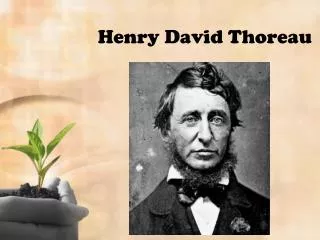
The Life and Legacy of Henry David Thoreau: A Pioneer of Simple Living and Civil Disobedience
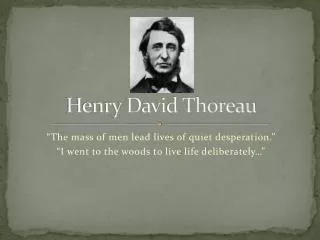
Henry David Thoreau (1817-1862), born in Concord, Massachusetts, was an influential philosopher and naturalist. A Harvard graduate who chose a life of simplicity, he famously retreated to a cabin by Walden Pond to reconnect with nature. His works reflect a disdain for societal norms and an advocacy for civil disobedience, notably against slavery and the Mexican War. Thoreau’s most poignant remark, “The mass of men lead lives of quiet desperation,” defines his belief in the inherent value of a life led authentically. He continues to inspire the pursuit of freedom and simplicity.


The Life and Legacy of Henry David Thoreau: A Pioneer of Simple Living and Civil Disobedience
E N D
Presentation Transcript
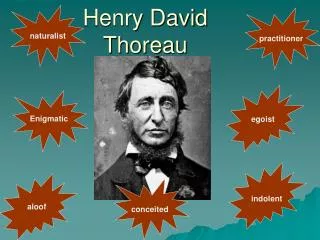
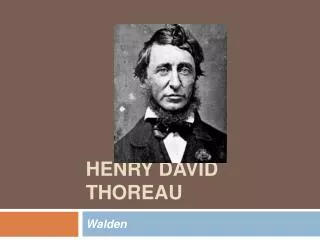
Henry David Thoreau 1817-1862
Thoreau was born in Concord, Massachusetts, in 1817. As a boy, he loved the woods and fields around his town. • He entered Harvard in 1833 and graduated four years later. • He never ranked higher than the middle of his class. • He was independent and eccentric, and he wore a green coat to chapel “because the rules required black.”
Thoreau seems to be the opposite of the great American self-made man. He, by his own choosing, became a self-UNMADE man. • He lasted only two weeks as a schoolteacher (he quit, refusing to whip a child). • The woman he proposed to turned him down. • He had little interest in the family business, despite his Harvard education.
At the age of 28, on July 4, 1845, he ended his three-year stay at the house of a friend and moved to a cabin on the shores of Walden Pond in Massachusetts. • The experiment was an attempt to rediscover the grandeur and heroism inherent in a simple life led close to nature.
One of Thoreau’s most famous remarks is: “The mass of men lead lives of quiet desperation.” • What does he mean?
Thoreau is also very famous for an act of civil disobedience. • He refused to pay taxes to support the Mexican War, which he felt would extend American slave-owning territory. • He was extremely opposed to slavery. • He spent the night in jail before someone paid the tax for him.
In 1861, Thoreau developed tuberculosis. • On his deathbed, his aunt asked him, “Have you made your peace with God?” Thoreau replied, “Why, Aunt, I didn’t know we had ever quarreled.”