Advances in Blade Performance: Insights from Recent Research and Testing
This document presents a comprehensive overview of recent research conducted by Caroline Cantley, Justin Greenhalgh, Mike Plissi, Norna Robertson, Calum Torrie, and Ian Wilmut on blade performance enhancements. It covers theoretical developments, practical test outcomes, and the formation of a dedicated 'Blade Committee'. Key topics include blade design equations, finite element analysis (FEA) on transmissibility, material properties, and testing methodologies. Conclusions emphasize the importance of standardizing materials, optimizing heat treatment processes, and investigating blade behavior under load. Future work focuses on further analysis and testing of current designs.

Advances in Blade Performance: Insights from Recent Research and Testing
E N D
Presentation Transcript
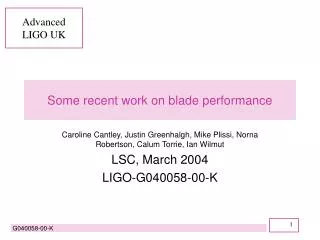
Some recent work on blade performance Caroline Cantley, Justin Greenhalgh, Mike Plissi, Norna Robertson, Calum Torrie, Ian Wilmut LSC, March 2004 LIGO-G040058-00-K
Contents • Theoretical work • “Blade committee” • Blade design equations • FEA on transmissibility • Practical work • Test blades of topmost ITM type • Blade test facility
Blade committee - 1 • Norna Robertson, Calum Torrie, Mike Plissi, Justin Greenhalgh, Caroline Cantley • Meet by telecon • Aim to pin down blade design issues: • How to predict blade performance (alpha and E) • Manufacturing processes • Selection of supplier • Heat treatment • Stress-relieving under load (?) • Load & factor of safety • Avoid “noisy” creep in use (also for clamps)
Blade committee - 2 • Conclusions so far: • Young’s Modulus varies between batches of maraging steel, so we should use a common manufacturer or maybe even a single order for the project. • Plan to make two large blades plus test samples at the same time, then measure E of samples and blade performance • Results from Virgo suggest that the heat treatment regime we have used may not be optimal, need to investigate further • Plan some tests at RAL using AE to look for noisy creep and, if found, verify that gentle heating under load removes it
Blade design equations • Rerun through blade design equations, simply restating results of others (T030285) • Non-linear FEA to look at initial deflection of blades • Very simple work at RAL, preliminary to transmissibility (T040024) • Some work to look at the relationship between FEA predictions and those of the blade design equations • Recheck of earlier results – alpha and Young’s modulus • Suggests that use of the geometric value of alpha plus measured value of E gives good fit to results.
FEA on blade transmissibility • To check that the transmissibility peaks associated with the internal modes of the three sets of blades would not interfere with each other • To assess the impact of wire clamp mass
Transmissibility • 0-1000 Hz • NB 1 Hz steps • Misses first bounce mode
Future work on transmissibility • Future work • Complete analysis of current blade designs • Compare with experimental results (eg Torrie thesis) • Especially, verify Q of blades
Blade test facility • Talk by Ian Wilmut
Blade test facility • What is it? • A simple way of experimenting with large blades, blade clamps, wire clamps etc… • The BTF resembles the upper-stage of a quad pendulum • Why are we building it? • To tie the blade theory up to real life • To allow blade sub systems to be iterated • Work on different designs of blade clamps • Work on different wire clamp designs • Work on different blade geometries • Provide test bed for eddy-current damping of blades • Allow different blade loading techniques to be tried
Blade Straightening • Previous blades have been straightened by loading with weights, a ETM would require 62kg per top stage spring. • Proposed alternative uses a roller to straighten the blades.
Blade clamps • 2 designs of the blade clamp • Library of clamps in a very similar arrangement as the mode cleaner. • Rotating design intended to provide blade tip height adjustments.
Wire Clamps • Initial wire clamp design to be similar to mode cleaner. • Rendering shows basic wire clamp • It is intended that we iterate on:- • Clamp grove design • Wire flexure point design • Definition of clean break-off
Plan of work with BTF • Flatten blades with blade straightening carriage. • Define alpha for quad upper blades using Young’s modulus measured from 10 samples of the same material. • 5 samples near surface • 5 samples near core, of ¼” material • Test idea for rotational adjuster • Iterate on wire clamp design details • Can be for other tests eg noisy creep