Evaluating Trigonometric Functions Using Reference Angles
320 likes | 453 Vues
This guide focuses on the evaluation of trigonometric functions for various angles using reference angles. It explains how to calculate sine, cosine, tangent, and their reciprocals for points lying on the terminal side of an angle in different quadrants. The guide also covers how to identify the quadrant based on the signs of the trigonometric functions and discusses the concept of quadrantal angles. Several examples include calculating the six trigonometric functions for specific points and determining reference angles for angles beyond 360 degrees.


Evaluating Trigonometric Functions Using Reference Angles
E N D
Presentation Transcript
Trigonometric Functions of Any Angles Objective: To evaluate trig functions of any angle by using reference angles
(x, y) θ r y r sin θ = csc θ = r y x r cos θ = sec θ = r x y x tan θ = cot θ = x y
Evaluate the six trigonometric functions if the point (-4,3) lies on the terminal side of an angle θ. 3 5 sin θ = csc θ = 5 3 -4 5 cos θ = sec θ = 5 -4 3 -4 tan θ = cot θ = -4 3
Evaluate the six trigonometric functions if the point (1,-3) lies on the terminal side of an angle θ. sin θ = csc θ = cos θ = sec θ = tan θ = cot θ =
Evaluate the six trigonometric functions if the point (-7,-4) lies on the terminal side of an angle θ. sin θ = csc θ = cos θ = sec θ = tan θ = cot θ =
Evaluate the six trigonometric functions if the point (3, 0) lies on the terminal side of an angle θ. sin θ = csc θ = cos θ = sec θ = tan θ = cot θ =
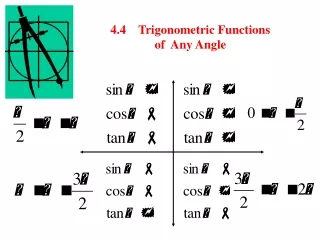
When Trig Functions are +/- sin, csc + cos, sec + tan, cot + sin, csc + cos, sec – tan, cot – II I (-,+) (+,+) III IV sin, csc – cos, sec – tan, cot + sin, csc – cos, sec + tan, cot – (-,-) (+,-)
Name the quadrant in which the angle lies. sinθ < 0 and cosθ < 0 sinθ > 0 and tanθ < 0 III II
Evaluate the six trigonometric functions if the point (0, 3) lies on the terminal side of an angle θ. sin θ = csc θ = cos θ = sec θ = tan θ = cot θ =
Evaluate the six trigonometric functions if the point (-3, 0) lies on the terminal side of an angle θ. sin θ = csc θ = cos θ = sec θ = tan θ = cot θ =
Evaluate the six trigonometric functions if the point (0, -3) lies on the terminal side of an angle θ. sin θ = csc θ = cos θ = sec θ = tan θ = cot θ =
90° (0,3) (3,0) If (3,0) is on the terminal side of the angle, then θ = 0°. If (0,3) is on the terminal side of the angle, then θ = 90°
180° 270° (-3,0) (0,-3) If (-3,0) is on the terminal side of the angle, then θ = 180° If (0,-3) is on the terminal side of the angle, then θ = 270°
Quadrantal Angle • Angle whose terminal side falls on an axis. • Examples: 0°, 90°, 180°, 270°, 360°
Reference Angles • The acute angle formed by the terminal side of the angle and the horizontal axis (x-axis). Remember: Must be positive Must be acute
Find the reference angle. 140° 180° – 140° = 40°
Find the reference angle. 230° 230° – 180° = 50°
Short-Cuts for Reference Angles θ θ 180° - θ π - θ θ - 180° θ - π 360° - θ 2π - θ θ - 360°. Then proceed with above. θ - 2π Then proceed with above.
Find the reference angle. 360° - 310° = 50° 310 170 305 180° - 170 ° = 10° 360° - 305° = 55°
Evaluate the following. 225° - 180° = 45° cos(45°) Quadrant III In Quadrant III, cos is negative. 180° - 120° = 60° Quadrant II tan(60°) In Quadrant II, tan is negative.
Evaluate the following. Quadrant III In Quadrant III, tan is positive.
Evaluate the following. Quadrant III In Quadrant III, sin is negative.
Find the reference angle. 375° - 360° = 15° 375 470 595 470° - 360 ° = 110° = 70° 180° - 110 ° 595° - 360° = 235° = 55° 235° - 180 °
Evaluate the following. It’s larger than 360°! 390° - 360° = 30° Quadrant I. sin(30°) In Quadrant I, sin is positive.
Evaluate the following. It’s larger than 2π! Quadrant I!
If θ is negative… • Add 360° (or 2π) until you get a positive angle. • Proceed as usual.
Find the reference angle. -275° + 360° = 85° -275 -190 -112 -190° + 360 ° = 170° = 10° 180° - 170° -112° + 360° = 248° = 68° 248° - 180 °
Find the reference angle. Quadrant III.
Evaluate the following. It’s negative. -120 + 360 = 240° Quadrant III. 240° - 180° = 60° sin(60°) In Quadrant III, sin is negative.