Download
1 / 2
20 likes | 128 Vues
This text explores the concept of momentum, explaining its relationship to mass and velocity through the formula ( p = m cdot v ). It discusses the differences in momentum between large objects, like ships, and smaller ones, like skateboards. The text introduces impulse as a force exerted over time and its connection to momentum, highlighting the conservation of momentum in collisions. Key examples illustrate elastic and inelastic collisions, reinforcing the idea that the total momentum before and after an event remains constant.

E N D
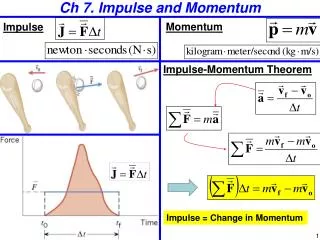
What’s the difference between a moving semi truck and a moving skateboard? Mass… but also… Ch. 8 - Momentum I. Momentum: Inertia (mass) in motion (velocity)… A. Momentum = mass x velocity B. p = mDv (SI units = kgm/s) C. Ships going full speed have huge momentum…Titanic II. Impulse: exerting a force over a time interval A. Impulse (no abb.) = Ft (SI units = Ns) B. ** D momentum = impulse mDv = Ft ** C. Ships coming into port, falling on carpet, catching an egg or ball!
III. Conservation of Momentum: Momentum of a system must be conserved A. Collisions – 2 types 1. Elastic (bouncy): Pool balls, Newton’s Cradle, etc. m1v1 + m2v2 = m1v3 + m2v4 2. Inelastic (sticky): Railroad cars, tackling, etc. m1v1 + m2v2 = (m1 + m2)v3 B. Momentum Vectors: Vector sums before a collision = sum of momentum vectors after a collision!