Understanding Cerebrovascular Diseases: A Comprehensive Guide to Stroke Management and Treatment
330 likes | 461 Vues
Join us for a detailed lecture series on cerebrovascular diseases, focusing on the essentials of stroke, including ischemic and hemorrhagic types. Learn about clinical diagnosis, treatment guidelines, and the role of neuroprotective agents in stroke management. Dive into the intricacies of supportive care, the importance of timely intervention with tPA, and protocols for managing intracerebral and subarachnoid hemorrhages. This engaging session will equip healthcare professionals with vital knowledge on handling brain attack emergencies effectively.


Understanding Cerebrovascular Diseases: A Comprehensive Guide to Stroke Management and Treatment
E N D
Presentation Transcript
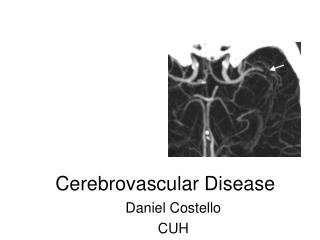
Cerebrovascular Disease Wednesday AM lecture series Mitch Deshazer
Focus on the basics • Stroke: ischemic, hemorrhagic • Subarachnoid hemorrhage
Stroke guidelines in 1 slide Clinical diagnosis Yell “Please page a Brain Attack to room X” Resume coffee drinking while watching the fun.
What the Brain Attack team does, as per 2008 guidelines Clinical diagnosis NIH stroke scale CT/MRI to confirm dx and determine type of stroke (level 1A recc), CT just as good as MRI
Then things diverge a bit • Ischemic stroke: • Supportive care: airway/breathing, fever control*, BP control if SBP over 180 for tPA, 220 otherwise*; (safe to restart outpt HTN meds in 24 hrs; CHHIPS study), euglycemia. • Go quick quick to tPA.
Stuff that doesn’t work • Heparin/ASA* • Hemodilution • Vasodialators • Induced hypertension if pt hypotensive • Combinations of thrombolytics↓ • “neuroprotective” agents—see next slide
No data on prophylactic anticonvulsants In ischemic stroke
To Do list- intracerebral bleed • Image head • Check for and correct coagulopathy (prothrombin complex concentrates or FFP, but NOT fVII) • Take blood pressure down to SBP 140s* • Fix hypoglycemia, not sure what to do with hyperglycemia; fix fever#, DVT SQ heparin ok after day 1-4 if no bleeding • I guess we should call neurosurgery
The other level 1A recommendation (clinical seizures only) Prophylaxis changes the frequency, but no evidence that seizures change outcomes
Within TBI literature, ICP monitors define 3 patient populations 1) Normal ICP 2) Abnormal ICP that responds to treatment; type of treatment appears unimportant 3) Abnormal ICP that doesn’t respond to treatment
Prognosis The ICH score is determined by adding the score from each component as follows: • Glasgow Coma Scale (GCS) score 3 to 4 (= 2 points); GCS 5 to 12 (= 1 point) and GCS 13 to 15 (= 0 points) • ICH volume ≥30 cm3 (= 1 point), ICH volume <30 cm3 (= 0 points) • Intraventricular extension of hemorrhage present (= 1 point); absent (= 0 points) • Infratentorial origin yes (= 1 point); no (= 0 points) • Age ≥80 (= 1 point); <80 (= 0 points) Thirty-day mortality rates increased steadily with ICH score; mortality rates for ICH scores of 1, 2, 3, 4, and 5 were 13, 26, 72, 97, and 100 percent, respectively. No patient with an ICH score of 0 died, and none had a score of 6 in the cohort
Clinical Presentation • “Worst headache of my life”--80% • Sentinel bleed—10% • AMS, vomiting, seizures, stiff neck, focal deficits • Diagnosis: CT scan, if negative LP • If positive, then either CTA, MRA, or angiography to spot the lesion
Hunt & Hess grading scale • Asymptomatic, mild headache, slight nuchal rigidity--1 • Moderate to severe headache, nuchal rigidity , no neurologic deficit other than cranial nerve pals--2 • Drowsiness / confusion, mild focal neurologic deficit--3 • Stupor, moderate-severe hemiparesis--4 • Coma, decerebrate posturing--5
General Concepts in management • Establish baseline TCD to watch for vasospasm • DVT with SCD until after coil/clip, then SQ hep • Get rid of all blood thinners • Nimodipine, baby. • HyperNa done frequently but without data • Fluctuations in BP thought to cause rebleed, so keep it even. Absolute value unclear. • Fix hypoxia, hypo- or hyperglycemia, pH
Stuff that doesn’t work Antfibrinolytic therapy—stops bleeding but causes more ischemic strokes Hypothermia Hemodilution, Hypertension, hypervolemia (triple H therapy)
Stuff that might work Infusion of urokinase into CSF to prevent vasospasm Statins to prevent vasospasm Magnesium sulfate to prevent vasospasm Unclear how to prevent rebleed